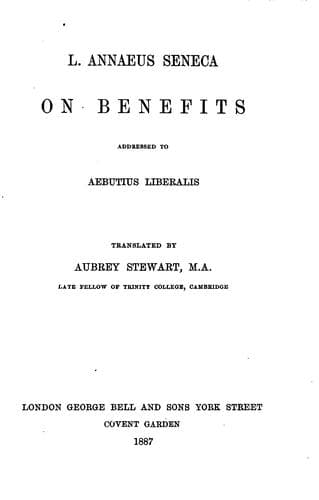
L. Annaeus Seneca on BenefitsSeneca, Lucius Annaeus
Philosophy
L. Annaeus Seneca on Benefits
Seneca, Lucius Annaeus
Benevolence; Classical literature; Conduct of life; Essays
VIII. Our school regards him as Father Liber, and Hercules, and
Mercurius: he is Father Liber because he is the parent of all, who first
discovered the power of seed, and our being led by pleasure to plant it;
he is Hercules, because his might is unconquered, and when it is wearied
after completing its labours, will retire into fire; he is Mercurius,
because in him is reasoning, and numbers, and system, and knowledge.
Whither-soever you turn yourself you will see him meeting you:
nothing is void of him, he himself fills his own work. Therefore, most
ungrateful of mortals, it is in vain that you declare yourself indebted,
not to God, but to nature, because there can be no God without nature,
nor any nature without God; they are both the same thing, differing only
in their functions. If you were to say that you owe to Annaeus or
to Lucius what you received from Seneca, you would not change your
creditor, but only his name, because he remains the same man whether you
use his first, second, or third name. So whether you speak of nature,
fate, or fortune, these are all names of the same God, using his power
in different ways. So likewise justice, honesty, discretion, courage,
frugality, are all the good qualities of one and the same mind; if you
are pleased with any one of these, you are pleased with that mind.
IX. However, not to drift aside into a distinct controversy, God bestows
upon us very many and very great benefits without hope of receiving any
return; since he does not require any offering from us, and we are
not capable of bestowing anything upon him: wherefore, a benefit is
desirable in itself. In it the advantage of the receiver is all that
is taken into consideration: we study this without regarding our own
interests. "Yet," argues our opponent, "you say that we ought to choose
with care the persons upon whom we bestow benefits, because neither do
husbandmen sow seed in the sand: now if this be true, we follow our own
interest in bestowing benefits, just as much as in ploughing and sowing:
for sowing is not desirable in itself. Besides this you inquire where
and how you ought to bestow a benefit, which would not need to be
done if the bestowal of a benefit was desirable in itself: because in
whatever place and whatever manner it might be bestowed, it still would
be a benefit." We seek to do honourable acts, solely because they are
honourable; yet even though we need think of nothing else, we consider
to whom we shall do them, and when, and how; for in these points the act
has its being. In like manner, when I choose upon whom I shall bestow
a benefit, and when I aim at making it a benefit; because if it were
bestowed upon a base person, it could neither be a benefit nor an
honourable action.
Public-domain text, read in full here on John Shaqi.
Reviews
Reviews
No reviews yet
Be the first to share your thoughts on this work.
Elsewhere in the archive
Join the Discussion
Join the discussion
Sign in to leave a comment or review.
Sign InorCreate an account