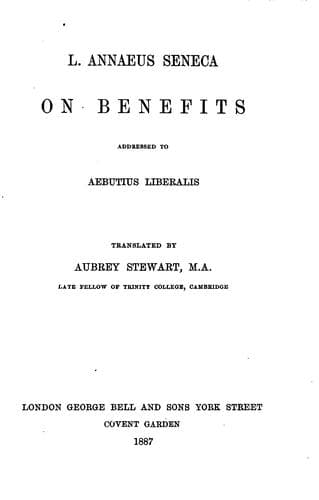
L. Annaeus Seneca on BenefitsSeneca, Lucius Annaeus
Philosophy
L. Annaeus Seneca on Benefits
Seneca, Lucius Annaeus
Benevolence; Classical literature; Conduct of life; Essays
XI. I do not fish for gain, for pleasure, or for credit, by bestowing
benefits: satisfied in doing so with pleasing one man alone, I shall
give in order to do my duty. Duty, however, leaves one some choice; do
you ask me, how I am to choose? I shall choose an honest, plain, man,
with a good memory, and grateful for kindness; one who keeps his hands
off other men's goods, yet does not greedily hold to his own, and who is
kind to others; when I have chosen such a man, I shall have acted to my
mind, although fortune may have bestowed upon him no means of returning
my kindness. If my own advantage and mean calculation made me liberal,
if I did no one any service except in order that he might in turn do a
service to me, I should never bestow a benefit upon one who was setting
out for distant and foreign countries, never to return; I should not
bestow a benefit upon one who was so ill as to be past hope of recovery,
nor should I do so when I myself was failing, because I should not live
long enough to receive any return. Yet, that you may know that to do
good is desirable in itself, we afford help to strangers who put into
our harbour only to leave it straightway; we give a ship and fit it out
for a shipwrecked stranger to sail back in to his own country. He leaves
us hardly knowing who it was who saved him, and, as he will never return
to our presence, he hands over his debt of gratitude to the gods, and
beseeches them to fulfil it for him: in the meanwhile we rejoice in the
barren knowledge that we have done a good action. What? when we stand
upon the extreme verge of life, and make our wills, do we not assign to
others benefits from which we ourselves shall receive no advantage? How
much time we waste, how long we consider in secret how much property we
are to leave, and to whom! What then? does it make any difference to us
to whom we leave our property, seeing that we cannot expect any return
from any one? Yet we never give anything with more care, we never take
such pains in deciding upon our verdict, as when, without any views of
personal advantage, we think only of what is honourable, for we are bad
judges of our duty as long as our view of it is distorted by hope and
fear, and that most indolent of vices, pleasure: but when death has shut
off all these, and brought us as incorrupt judges to pronounce sentence,
we seek for the most worthy men to leave our property to, and we never
take more scrupulous care than in deciding what is to be done with what
does not concern us. Yet, by Hercules, then there steals over us a
great satisfaction as we think, "I shall make this man richer, and by
bestowing wealth upon that man I shall add lustre to his high position."
Indeed, if we never give without expecting some return, we must all die
without making our wills.
Public-domain text, read in full here on John Shaqi.
Reviews
Reviews
No reviews yet
Be the first to share your thoughts on this work.
Elsewhere in the archive
Join the Discussion
Join the discussion
Sign in to leave a comment or review.
Sign InorCreate an account