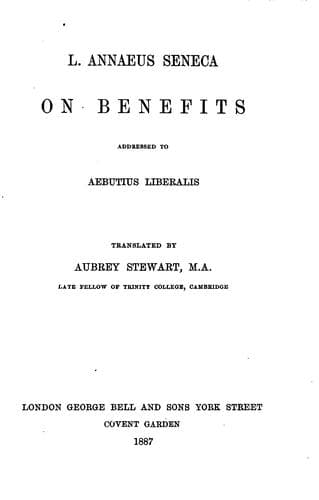
L. Annaeus Seneca on BenefitsSeneca, Lucius Annaeus
Philosophy
L. Annaeus Seneca on Benefits
Seneca, Lucius Annaeus
Benevolence; Classical literature; Conduct of life; Essays
XII. It may be said, "You define a benefit as a loan which cannot be
repaid: now a loan is not a desirable thing in itself." When we speak of
a loan, we make use of a figure, or comparison, just as we speak of law
as; the standard of right and wrong, although a standard is not a thing
to be desired for its own sake. I have adopted this phrase in order to
illustrate my subject: when I speak of a loan, I must be understood to
mean something resembling a loan. Do you wish to know how it differs
from one? I add the words "which cannot be repaid," whereas every loan
both can and ought to be repaid. It is so far from being right to bestow
a benefit for one's own advantage, that often, as I have explained, it
is one's duty to bestow it when it involves one's own loss and risk: for
instance, if I assist a man when beset by robbers, so that he gets away
from them safely, or help some victim of power, and bring upon myself
the party spite of a body of influential men, very, probably incurring
myself the same disgrace from which I saved him, although I might have
taken the other side, and looked on with safety at struggles with
which I have nothing to do: if I were to give bail for one who has been
condemned, and when my friend's goods were advertised for sale I were
to give a bond to the effect that I would make restitution to the
creditors, if, in order to save a proscribed person I myself run the
risk of being proscribed. No one, when about to buy a villa at Tusculum
or Tibur, for a summer retreat, because of the health of the locality,
considers how many years' purchase he gives for it; this must be looked
to by the man who makes a profit by it. The same is true with benefits;
when you ask what return I get for them, I answer, the consciousness
of a good action. "What return does one get for benefits?" Pray tell
me what return one gets for righteousness, innocence, magnanimity,
chastity, temperance? If you wish for anything beyond these virtues, you
do not wish for the virtues themselves. For what does the order of the
universe bring round the seasons? for what does the sun make the day
now longer and now shorter? all these things are benefits, for they take
place for our good. As it is the duty of the universe to maintain the
round of the seasons, as it is the duty of the sun to vary the points of
his rising and setting, and to do all these things by which we profit,
without any reward, so is it the duty of man, amongst other things, to
bestow benefits. Wherefore then does he give? He gives for fear that
he should not give, lest he might lose an opportunity of doing a good
action.
Public-domain text, read in full here on John Shaqi.
Reviews
Reviews
No reviews yet
Be the first to share your thoughts on this work.
Elsewhere in the archive
Join the Discussion
Join the discussion
Sign in to leave a comment or review.
Sign InorCreate an account