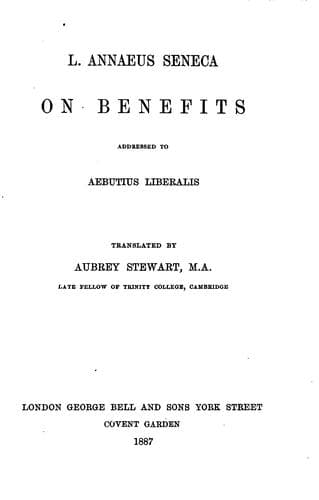
L. Annaeus Seneca on BenefitsSeneca, Lucius Annaeus
Philosophy
L. Annaeus Seneca on Benefits
Seneca, Lucius Annaeus
Benevolence; Classical literature; Conduct of life; Essays
XXVII. We call some men timid because they are fools: in this they
are like the bad men who are steeped in all vices without distinction.
Strictly speaking, we call those persons timid who are alarmed even
at unmeaning noises. A fool possesses all vices, but he is not equally
inclined by nature to all; one is prone to avarice, another to luxury,
and another to insolence. Those persons, therefore, are mistaken, who
ask the Stoics, "What do you say, then? is Achilles timid? Aristides,
who received a name for justice, is he unjust? Fabius, who 'by delays
retrieved the day,' is he rash? Does Decius fear death? Is Mucius
a traitor? Camillus a betrayer?" We do not mean that all vices are
inherent in all men in the same way in which some especial ones are
noticeable in certain men, but we declare that the bad man and the fool
possess all vices; we do not even acquit them of fear when they are
rash, or of avarice when they are extravagant. Just as a man has all his
senses, yet all men have not on that account as keen a sight as Lynceus,
so a man that is a fool has not all vices in so active and vigorous a
form as some persons have spine of them, yet he has them all. All vices
exist in all of them, yet all are not prominent in each individual. One
man is naturally prone to avarice, another is the slave of wine, a third
of lust; or, if not yet enslaved by these passions, he is so fashioned
by nature that this is the direction in which his character would
probably lead him. Therefore, to return to my original proposition,
every bad man is ungrateful, because he has the seeds of every villainy
in him; but he alone is rightly so called who is naturally inclined to
this vice. Upon such a person as this, therefore, I shall not bestow a
benefit. One who betrothed his daughter to an ill-tempered man from whom
many women had sought a divorce, would be held to have neglected her
interests; a man would be thought a bad father if he entrusted the care
of his patrimony to one who had lost his own family estate, and it would
be the act of a madman to make a will naming as the guardian of one's
son a man who had already defrauded other wards. So will that man be
said to bestow benefits as badly as possible, who chooses ungrateful
persons, in whose hands they will perish.
Public-domain text, read in full here on John Shaqi.
Reviews
Reviews
No reviews yet
Be the first to share your thoughts on this work.
Elsewhere in the archive
Join the Discussion
Join the discussion
Sign in to leave a comment or review.
Sign InorCreate an account