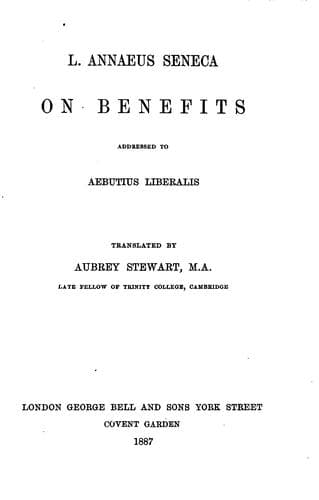
L. Annaeus Seneca on BenefitsSeneca, Lucius Annaeus
Philosophy
L. Annaeus Seneca on Benefits
Seneca, Lucius Annaeus
Benevolence; Classical literature; Conduct of life; Essays
XXVI. "If," our adversary may say, "you wish to imitate the gods, then
bestow benefits upon the ungrateful as well as the grateful; for the
sun rises upon the wicked as well as the good, the seas are open even
to pirates." By this question he really asks whether a good man
would bestow a benefit upon an ungrateful person, knowing him to be
ungrateful. Allow me here to introduce a short explanation, that we may
not be taken in by a deceitful question. Understand that according to
the system of the Stoics there are two classes of ungrateful persons.
One man is ungrateful because he is a fool; a fool is a bad man; a man
who is bad possesses every vice: therefore he is ungrateful. In the same
way we speak of all bad men as dissolute, avaricious, luxurious, and
spiteful, not because each man has all these vices in any great or
remarkable degree, but because he might have them; they are in him, even
though they be not seen. The second form of ungrateful person is he who
is commonly meant by the term, one who is inclined by nature to this
vice. In the case of him who has the vice of ingratitude just as he has
every other, a wise man will bestow a benefit, because if he sets aside
all such men there will be no one left for him to bestow it on. As for
the ungrateful man who habitually misapplies benefits and acts so by
choice, he will no more bestow a benefit upon him than he would lend
money to a spendthrift, or place a deposit in the hands of one who had
already often refused to many persons to give up the property with which
they had entrusted him.
Public-domain text, read in full here on John Shaqi.
Reviews
Reviews
No reviews yet
Be the first to share your thoughts on this work.
Elsewhere in the archive
Join the Discussion
Join the discussion
Sign in to leave a comment or review.
Sign InorCreate an account