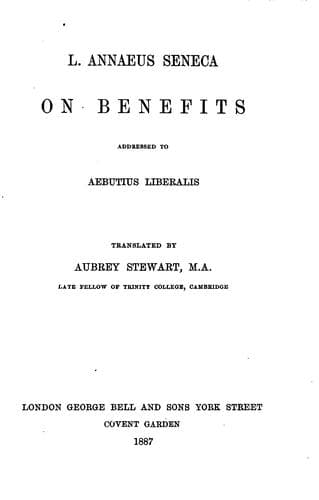
L. Annaeus Seneca on BenefitsSeneca, Lucius Annaeus
Philosophy
L. Annaeus Seneca on Benefits
Seneca, Lucius Annaeus
Benevolence; Classical literature; Conduct of life; Essays
XXIX. "Shall we, then," argues he, "not give our advice to an ungrateful
man when he is at a loss, or refuse him a drink of water when he is
thirsty, or not show him the path when he has lost his way? or would you
do him these services and yet not give him anything?" Here I will draw
a distinction, or at any rate endeavour to do so. A benefit is a useful
service, yet all useful service is not a benefit; for some are so
trifling as not to claim the title of benefits. To produce a benefit two
conditions must concur. First, the importance of the thing given; for
some things fall short of the dignity of a benefit. Who ever called a
hunch of bread a benefit, or a farthing dole tossed to a beggar, or the
means of lighting a fire? yet sometimes these are of more value than the
most costly benefits; still their cheapness detracts from their value
even when, by the exigency of time, they are rendered essential. The
next condition, which is the most important of all, must necessarily be
present, namely, that I should confer the benefit for the sake of him
whom I wish to receive it, that I should judge him worthy of it, bestow
it of my own free will, and receive pleasure from my own gift, none
of which conditions are present in the cases of which we have just now
spoken; for we do not bestow such things as those upon these who are
worthy of them, but we give them carelessly, as trifles, and do not give
them so much to a man as to humanity.
XXX. I shall not deny that sometimes I would give even to the unworthy,
out of respect for others; as, for instance, in competition for public
offices, some of the basest of men are preferred on account of their
noble birth, to industrious men of no family, and that for good reasons;
for the memory of great virtues is sacred, and more men will take
pleasure in being good, if the respect felt for good men does not cease
with their lives. What made Cicero's son a consul, except his father?
What lately brought Cinna [Footnote: See Seneca on "Clemency," book i.,
ch. ix.] out of the camp of the enemy and raised him to the consulate?
What made Sextus Pompeius and the other Pompeii consuls, unless it was
the greatness of one man, who once was raised so high that, by his very
fall, he sufficiently exalted all his relatives. What lately made Fabius
Persicus a member of more than one college of priests, though even
profligates avoided his kiss? Was it not Verrucosus, and Allobrogicus,
and the three hundred who to serve their country blocked the invader's
path with the force of a single family? It is our duty to respect the
virtuous, not only when present with us, but also when removed from our
sight: as they have made it their study not to bestow their benefits
upon one age alone, but to leave them existing after they themselves
have passed away, so let us not confine our gratitude to a single
age. If a man has begotten great men, he deserves to receive benefits,
whatever he himself may be: he has given us worthy men. If a man
Public-domain text, read in full here on John Shaqi.
Reviews
Reviews
No reviews yet
Be the first to share your thoughts on this work.
Elsewhere in the archive
Join the Discussion
Join the discussion
Sign in to leave a comment or review.
Sign InorCreate an account