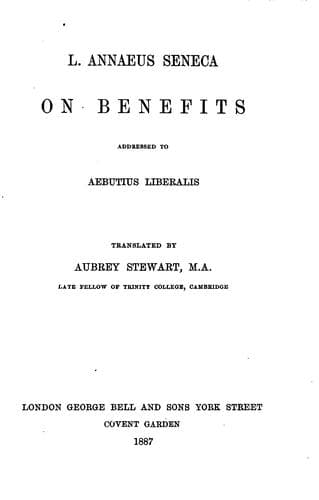
L. Annaeus Seneca on BenefitsSeneca, Lucius Annaeus
Philosophy
L. Annaeus Seneca on Benefits
Seneca, Lucius Annaeus
Benevolence; Classical literature; Conduct of life; Essays
descends from glorious ancestors, whatever he himself may be, let him
find refuge under the shadow of his ancestry. As mean places are lighted
up by the rays of the sun, so let the degenerate shine in the light of
their forefathers.
XXXI. In this place, my Liberalis, I wish to speak in defence of the
gods. We sometimes say, "What could Providence mean by placing an
Arrhidaeus upon the throne?" Do you suppose that the crown was given
to Arrhidaeus? nay, it was given to his father and his brother. Why
did Heaven bestow the empire of the world upon Caius Caesar, the most
bloodthirsty of mankind, who was wont to order blood to be shed in his
presence as freely as if he wished to drink of it? Why, do you suppose
that it was given to him? It was given to his father, Germanicus, to his
grandfather, his great grandfather, and to others before them, no less
illustrious men, though they lived as private citizens on a footing
of equality with others. Why, when you yourself were making Mamercus
Scaurus consul, were you ignorant of his vices? did he himself conceal
them? did he wish to appear decent?
Did you admit a man who was so openly filthy to the fasces and the
tribunal? Yes, it was because you were thinking of the great old
Scaurus, the chief of the Senate, and were unwilling that his descendant
should be despised.
XXXII. It is probable that the gods act in the same manner, that they
show greater indulgence to some for the sake of their parents and
their ancestry, and to others for the sake of their children and
grandchildren, and a long line of descendants beyond them; for they
know the whole course of their works, and have constant access to the
knowledge of all that shall hereafter pass through their hands. These
things come upon us from the unknown future, and the gods have foreseen
and are familiar with the events by which we are startled. "Let these
men," says Providence, "be kings, because their ancestors were good
kings, because they regarded righteousness and temperance as the highest
rule of life, because they did not devote the state to themselves, but
devoted themselves to the state. Let these others reign, because some
one of their ancestors before them was a good man, who bore a soul
superior to fortune, who preferred to be conquered rather than to
conquer in civil strife, because it was more to the advantage of
the state. [Footnote: Gertz, "Stud. Crit," p. 159, note.] It was not
possible to make a sufficient return to him for this during so long a
time; let this other, therefore, out of regard for him, be chief of the
people, not because he knows how, or is capable, but because the other
has earned it for him. This man is misshapen, loathsome to look upon,
and will disgrace the insignia of his office. Men will presently blame
me, calling me blind and reckless, not knowing upon whom I am conferring
what ought to be given to the greatest and noblest of men; but I know
that, in giving this dignity to one man, I am paying an old debt to
Public-domain text, read in full here on John Shaqi.
Reviews
Reviews
No reviews yet
Be the first to share your thoughts on this work.
Elsewhere in the archive
Join the Discussion
Join the discussion
Sign in to leave a comment or review.
Sign InorCreate an account