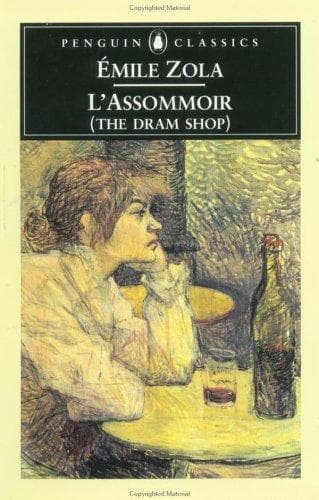
Domestic fiction; Married women -- Fiction; Paris (France) -- Fiction; Working class women -- Fiction
The two did not exchange a dozen words. They could not have more
completely satisfied their love if alone in a room with the door
double-locked. The snickering of Salted-Mouth, otherwise
Drink-without-Thirst, did not bother them in the least, for they no
longer even heard him. At the end of a quarter of an hour she would
begin to feel slightly oppressed; the heat, the powerful smell, the
ascending smoke, made her dizzy, whilst the dull thuds of the hammers
shook her from the crown of her head to the soles of her feet. Then she
desired nothing more; it was her pleasure. Had Goujet pressed her in
his arms it would not have procured her so sweet an emotion. She drew
close to him that she might feel the wind raised by his hammer beat
upon her cheek, and become, as it were, a part of the blow he struck.
When the sparks made her soft hands smart, she did not withdraw them;
on the contrary, she enjoyed the rain of fire which stung her skin. He
for certain, divined the happiness which she tasted there; he always
kept the most difficult work for the Fridays, so as to pay his court to
her with all his strength and all his skill; he no longer spared
himself at the risk of splitting the anvils in two, as he panted and
his loins vibrated with the joy he was procuring her. All one
spring-time their love thus filled Goujet with the rumbling of a storm.
It was an idyll amongst giant-like labor in the midst of the glare of
the coal fire, and of the shaking of the shed, the cracking carcass of
which was black with soot. All that beaten iron, kneaded like red wax,
preserved the rough marks of their love. When on the Fridays the
laundress parted from Golden-Mug, she slowly reascended the Rue des
Poissonniers, contented and tired, her mind and her body alike
tranquil.
Little by little, her fear of Lantier diminished; her good sense got
the better of her. At that time she would still have led a happy life,
had it not been for Coupeau, who was decidedly going to the bad. One
day she just happened to be returning from the forge, when she fancied
she recognized Coupeau inside Pere Colombe’s l’Assommoir, in the act of
treating himself to a round of vitriol in the company of My-Boots,
Bibi-the-Smoker, and Salted-Mouth, otherwise Drink-without-Thirst. She
passed quickly by, so as not to seem to be spying on them. But she
glanced back; it was indeed Coupeau who was tossing his little glass of
bad brandy down his throat with a gesture already familiar. He lied
then; so he went in for brandy now! She returned home in despair; all
her old dread of brandy took possession of her. She forgave the wine,
because wine nourishes the workman; all kinds of spirit, on the
contrary, were filth, poisons which destroyed in the workman the taste
for bread. Ah! the government ought to prevent the manufacture of such
horrid stuff!
Public-domain text, read in full here on John Shaqi.
Reviews
Reviews
No reviews yet
Be the first to share your thoughts on this work.
Elsewhere in the archive
Join the Discussion
Join the discussion
Sign in to leave a comment or review.
Sign InorCreate an account