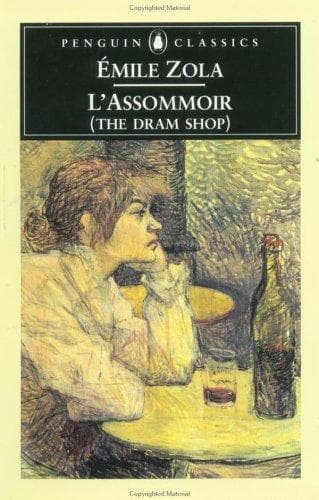
Domestic fiction; Married women -- Fiction; Paris (France) -- Fiction; Working class women -- Fiction
Then the furniture for the room had to be sorted out. Gervaise left
mother Coupeau’s wardrobe where it was, and added a table and two
chairs taken from her own room. She had to buy a washing-stand and a
bed with mattress and bedclothes, costing one hundred and thirty
francs, which she was to pay off at ten francs a month. Although
Lantier’s twenty francs would be used to pay off these debts for ten
months, there would be a nice little profit later.
It was during the early days of June that the hatter moved in. The day
before, Coupeau had offered to go with him and fetch his box, to save
him the thirty sous for a cab. But the other became quite embarrassed,
saying that the box was too heavy, as though he wished up to the last
moment to hide the place where he lodged. He arrived in the afternoon
towards three o’clock. Coupeau did not happen to be in. And Gervaise,
standing at the shop door became quite pale on recognizing the box
outside the cab. It was their old box, the one with which they had
journeyed from Plassans, all scratched and broken now and held together
by cords. She saw it return as she had often dreamt it would and it
needed no great stretch of imagination to believe that the same cab,
that cab in which that strumpet of a burnisher had played her such a
foul trick, had brought the box back again. Meanwhile Boche was giving
Lantier a helping hand. The laundress followed them in silence and
feeling rather dazed. When they had deposited their burden in the
middle of the room she said for the sake of saying something:
“Well! That’s a good thing finished, isn’t it?”
Then pulling herself together, seeing that Lantier, busy in undoing the
cords was not even looking at her, she added:
“Monsieur Boche, you must have a drink.”
And she went and fetched a quart of wine and some glasses.
Just then Poisson passed along the pavement in uniform. She signaled to
him, winking her eye and smiling. The policeman understood perfectly.
When he was on duty and anyone winked their eye to him it meant a glass
of wine. He would even walk for hours up and down before the laundry
waiting for a wink. Then so as not to be seen, he would pass through
the courtyard and toss off the liquor in secret.
“Ah! ah!” said Lantier when he saw him enter, “it’s you, Badingue.”
He called him Badingue for a joke, just to show how little he cared for
the Emperor. Poisson put up with it in his stiff way without one
knowing whether it really annoyed him or not. Besides the two men,
though separated by their political convictions, had become very good
friends.
“You know that the Emperor was once a policeman in London,” said Boche
in his turn. “Yes, on my word! He used to take the drunken women to the
station-house.”
Public-domain text, read in full here on John Shaqi.
Reviews
Reviews
No reviews yet
Be the first to share your thoughts on this work.
Elsewhere in the archive
Join the Discussion
Join the discussion
Sign in to leave a comment or review.
Sign InorCreate an account