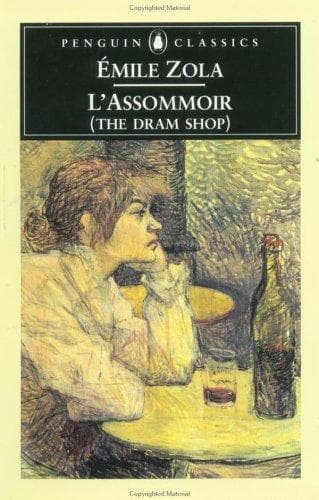
Domestic fiction; Married women -- Fiction; Paris (France) -- Fiction; Working class women -- Fiction
Gervaise had filled three glasses on the table. She would not drink
herself, she felt too sick at heart, but she stood there longing to see
what the box contained and watching Lantier remove the last cords.
Before raising the lid Lantier took his glass and clinked it with the
others.
“Good health.”
“Same to you,” replied Boche and Poisson.
The laundress filled the glasses again. The three men wiped their lips
on the backs of their hands. And at last the hatter opened the box. It
was full of a jumble of newspapers, books, old clothes and underlinen,
in bundles. He took out successively a saucepan, a pair of boots, a
bust of Ledru-Rollin with the nose broken, an embroidered shirt and a
pair of working trousers. Gervaise could smell the odor of tobacco and
that of a man whose linen wasn’t too clean, one who took care only of
the outside, of what people could see.
The old hat was no longer in the left corner. There was a pincushion
she did not recognize, doubtless a present from some woman. She became
calmer, but felt a vague sadness as she continued to watch the objects
that appeared, wondering if they were from her time or from the time of
others.
“I say, Badingue, do you know this?” resumed Lantier.
He thrust under his nose a little book printed at Brussels. “The Amours
of Napoleon III.,” Illustrated with engravings. It related, among other
anecdotes, how the Emperor had seduced a girl of thirteen, the daughter
of a cook; and the picture represented Napoleon III., bare-legged, and
also wearing the grand ribbon of the Legion of Honor, pursuing a little
girl who was trying to escape his lust.
“Ah! that’s it exactly!” exclaimed Boche, whose slyly ridiculous
instincts felt flattered by the sight. “It always happens like that!”
Poisson was seized with consternation, and he could not find a word to
say in the Emperor’s defense. It was in a book, so he could not deny
it. Then, Lantier, continuing to push the picture under his nose in a
jeering way, he extended his arms and exclaimed:
“Well, so what?”
Lantier didn’t reply. He busied himself arranging his books and
newspapers on a shelf in the wardrobe. He seemed upset not to have a
small bookshelf over his table, so Gervaise promised to get him one. He
had “The History of Ten Years” by Louis Blanc (except for the first
volume), Lamartine’s “The Girondins” in installments, “The Mysteries of
Paris” and “The Wandering Jew” by Eugene Sue, and a quantity of
booklets on philosophic and humanitarian subjects picked up from used
book dealers.
His newspapers were his prized possessions, a collection made over a
number of years. Whenever he read an article in a cafe that seemed to
him to agree with his own ideas, he would buy that newspaper and keep
it. He had an enormous bundle of them, papers of every date and every
title, piled up in no discernable order. He patted them and said to the
other two:
Public-domain text, read in full here on John Shaqi.
Reviews
Reviews
No reviews yet
Be the first to share your thoughts on this work.
Elsewhere in the archive
Join the Discussion
Join the discussion
Sign in to leave a comment or review.
Sign InorCreate an account