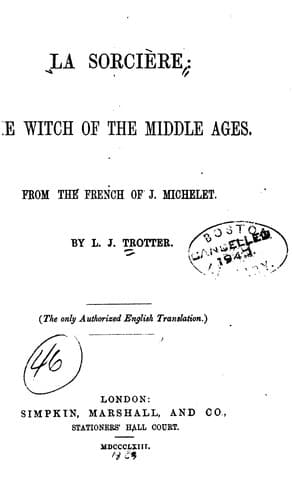
La Sorcière: The Witch of the Middle AgesMichelet, Jules
History
La Sorcière: The Witch of the Middle Ages
Michelet, Jules
Demonomania -- History -- To 1500; Satanism -- History -- To 1500; Superstition -- History -- To 1500; Witchcraft -- History -- To 1500
Then begins a period of increasing terror, in which men trust
themselves less and ever less to God’s protection. The Demon is no
longer a stealthy sprite, no longer a thief by night, gliding through
the gloom. He becomes the fearless adversary, the daring ape of
Heaven, who in broad daylight mimics God’s creation under God’s own
sun. Is it the legends tell us this? Nay, it is the greatest of the
doctors. “The Devil,” says Albert the Great, “transforms all living
things.” St. Thomas goes yet further. “All changes that may occur
naturally by means of seeds, can be copied by the Devil.” What an
astounding concession, which coming from the mouth of so grave a
personage, means nothing short of setting up one Creator face to face
with another! “But in things done without the germinal process,” he
adds, “such as the changing of men into beasts or the resurrection of
the dead, there the Devil can do nothing.” Thus to God is left the
smaller part of His work! He may only perform miracles, a kind of
action alike singular and infrequent. But the daily miracle of life is
not for Him alone: His copyist, the Devil, shares with Him the world
of nature!
For man himself, whose weak eyes see no difference between nature as
sprung from God and nature as made by the Devil, here is a world split
in twain! A dreadful uncertainty hangs over everything. Nature’s
innocence is gone. The clear spring, the pale flower, the little bird,
are these indeed of God, or only treacherous counterfeits, snares laid
out for man? Back! all things look doubtful! The better of the two
creations, being suspiciously like the other, becomes eclipsed and
conquered. The shadow of the Devil covers up the day, spreads over all
life. To judge by appearances and the fears of men, he has ceased to
share the world; he has taken it all to himself.
So matters stand in the days of Sprenger. His book teems with saddest
avowals of God’s weakness. “These things,” he says, “are done with
God’s leave.” To permit an illusion so entire, to let people believe
that God is nought and the Devil everything, is more than mere
_permission_; is tantamount to decreeing the damnation of countless
souls whom nothing can save from such an error. No prayers, no
penances, no pilgrimages, are of any avail; nor even, so it is said,
the sacrament of the altar. Strange and mortifying avowal! The very
nuns who have just confessed themselves, declare _while the host is
yet in their mouths_, that even then they feel the infernal lover
troubling them without fear or shame, troubling and refusing to leave
his hold. And being pressed with further questions, they add, through
their tears, that he has a body _because he has a soul_.
* * * * *
Public-domain text, read in full here on John Shaqi.
Reviews
Reviews
No reviews yet
Be the first to share your thoughts on this work.
Elsewhere in the archive
Join the Discussion
Join the discussion
Sign in to leave a comment or review.
Sign InorCreate an account