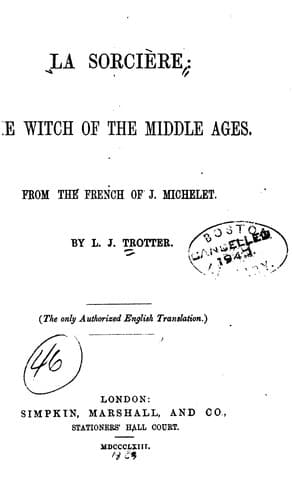
La Sorcière: The Witch of the Middle AgesMichelet, Jules
History
La Sorcière: The Witch of the Middle Ages
Michelet, Jules
Demonomania -- History -- To 1500; Satanism -- History -- To 1500; Superstition -- History -- To 1500; Witchcraft -- History -- To 1500
The Manichees of old, and the more modern Albigenses, were charged
with believing in the Power of Evil struggling side by side with Good,
with making the Devil equal to God. Here, however, he is more than
equal; for if God through His holy sacrament has still no power for
good, the Devil certainly seems superior.
I am not surprised at the wondrous sight then offered by the world.
Spain with a darksome fury, Germany with the frightened pedantic rage
certified in the _Malleus_, assail the insolent conqueror through the
wretches in whom he chooses to dwell. They burn, they destroy the
dwellings in which he has taken up his abode. Finding him too strong
for men’s souls, they try to hunt him out of their bodies. But what is
the good of it all? You burn one old woman and he settles himself in
her neighbour. Nay, more; if Sprenger may be trusted, he fastens
sometimes on the exorcising priest, and triumphs over his very judge.
Among other expedients, the Dominicans advised recourse to the
intercession of the Virgin, by a continual repeating of the _Ave
Maria_. Sprenger, for his part, always averred that such a remedy was
but a momentary one. You might be caught between two prayers. Hence
came the invention of the rosary, the chaplet of beads, by means of
which any number of aves might be mumbled through, whilst the mind was
busied elsewhere. Whole populations adopted this first essay of an art
thereafter to be used by Loyola in his attempt to govern the world, an
art of which his _Exercises_ furnish the ingenious groundwork.
* * * * *
All this seems opposed to what was said in the foregoing chapter as to
the decline of Witchcraft. The Devil is now popular and everywhere
present. He seems to have come off conqueror: but has he gained by
his victory? What substantial profit has he reaped therefrom?
Much, as beheld in his new phase of a scientific rebellion which is
about to bring forth the bright Renaissance. None, if beheld under his
old aspect, as the gloomy Spirit of Witchcraft. The stories told of
him in the sixteenth century, if more numerous, more widespread than
ever, readily swing towards the grotesque. People tremble, but they
laugh withal.[76]
[76] See my _Memoirs of Luther_, concerning the Kilcrops, &c.
CHAPTER III.
CENTURY OF TOLERATION IN FRANCE: REACTION.
The Church forfeited the wizard’s property to the judge and the
prosecutor. Wherever the Canon Law was enforced the trials for
witchcraft waxed numerous, and brought much wealth to the clergy.
Wherever the lay tribunals claimed the management of these trials they
grew scarce and disappeared, at least for a hundred years in France,
from 1450 to 1550.
Public-domain text, read in full here on John Shaqi.
Reviews
Reviews
No reviews yet
Be the first to share your thoughts on this work.
Elsewhere in the archive
Join the Discussion
Join the discussion
Sign in to leave a comment or review.
Sign InorCreate an account