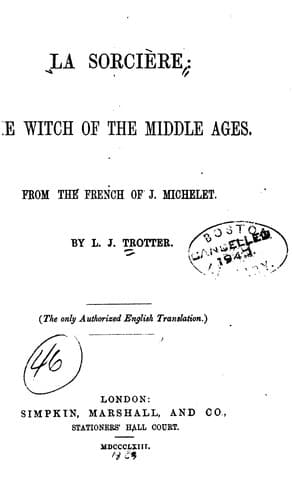
La Sorcière: The Witch of the Middle AgesMichelet, Jules
History
La Sorcière: The Witch of the Middle Ages
Michelet, Jules
Demonomania -- History -- To 1500; Satanism -- History -- To 1500; Superstition -- History -- To 1500; Witchcraft -- History -- To 1500
The first gleam of light shot forth from France in the middle of the
fifteenth century. The inquiry made by Parliament into the trial of
Joan of Arc, and her after reinstalment, set people thinking on the
intercourse of spirits, good and bad; on the errors, also, of the
spiritual courts. She whom the English, whom the greatest doctors of
the Council of Basil pronounced a Witch, appeared to Frenchmen a saint
and sibyl. Her reinstalment proclaimed to France the beginning of an
age of toleration. The Parliament of Paris likewise reinstalled the
alleged Waldenses of Arras. In 1498 it discharged as mad one who was
brought before it as a wizard. None such were condemned in the reigns
of Charles VIII., Louis XII., and Francis I.
* * * * *
On the contrary, Spain, under the pious Isabella (1506) and the
Cardinal Ximenes, began burning witches. In 1515, Geneva, being then
under a Bishop, burned five hundred in three months. The Emperor
Charles V., in his German Constitutions, vainly sought to rule, that
“Witchcraft, as causing damage to goods and persons, is a question for
_civil_, not ecclesiastic law.” In vain did he do away the right of
confiscation, except in cases of treason. The small prince-bishops,
whose revenues were largely swelled by trials for witchcraft, kept on
burning at a furious rate. In one moment, as it were, six hundred
persons were burnt in the infinitesimal bishopric of Bamberg, and nine
hundred in that of Wurtzburg. The way of going to work was very
simple. Begin by using torture against the witnesses; create witnesses
for the prosecution by means of pain and terror; then, by dint of
excessive kindliness, draw from the accused a certain avowal, and
believe that avowal in the teeth of proven facts. A witch, for
instance, owns to having taken from the graveyard the body of an
infant lately dead, that she might use it in her magical compounds.
Her husband bids them go the graveyard, for the child is there still.
On being disinterred, the child is found all right in his coffin. But
against the witness of his own eyes the judge pronounces it _an
appearance_, a cheat of the Devil. He prefers the wife’s confession to
the fact itself; and she is burnt forthwith.[77]
[77] For this and other facts regarding Germany, see Soldan.
So far did matters go among these worthy prince-bishops, that after a
while, Ferdinand II., the most bigoted of all emperors, the emperor of
the Thirty Years’ War, was fain to interfere, to set up at Bamberg an
imperial commissary, who should maintain the law of the empire, and
see that the episcopal judge did not begin the trial with tortures
which settled it beforehand, which led straight to the stake.
* * * * *
Public-domain text, read in full here on John Shaqi.
Reviews
Reviews
No reviews yet
Be the first to share your thoughts on this work.
Elsewhere in the archive
Join the Discussion
Join the discussion
Sign in to leave a comment or review.
Sign InorCreate an account