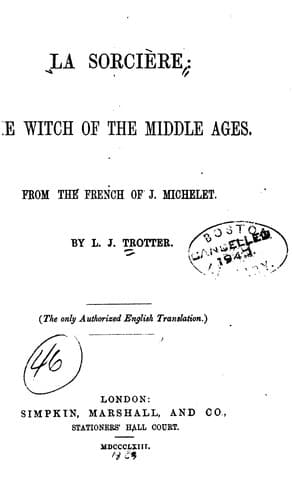
La Sorcière: The Witch of the Middle AgesMichelet, Jules
History
La Sorcière: The Witch of the Middle Ages
Michelet, Jules
Demonomania -- History -- To 1500; Satanism -- History -- To 1500; Superstition -- History -- To 1500; Witchcraft -- History -- To 1500
He likes everything to go off quite respectably, and spares no cost
in his scenic arrangements. Besides the customary flames, red, yellow,
and blue, which entertain the eye, as they show forth or hide the
flickering shadows, he charms the ear with strange music, mainly of
little bells that tickle the nerves with something like the searching
vibrations of musical-glasses. To crown this splendour Satan bids them
bring out his silver plate. Even his toads give themselves airs,
become fashionable, and, like so many lordlings, go about in green
velvet.
The general effect is that of a large fair, of a great masked ball
with very transparent disguises. Satan, who understands his epoch,
opens the ball with the Bishop of the Sabbath; or the King and Queen:
offices devised in compliment to the great personages, wealthy or
well-born, who honour the meeting by their presence.
Here may be seen no longer the gloomy feast of rebels, the baleful
orgie of serfs and boors, sharing by night the sacrament of love, by
day the sacrament of death. The violent Sabbath-round is no more the
one only dance of the evening. Thereto are now added the Moorish
dances, lively or languishing, but always amorous and obscene, in
which girls dressed up for the purpose, like _La Murgui_ or _La
Lisalda_, feigned and showed off the most provoking characters. Among
the Basques these dances formed, we are told, the invincible charm
which sent the whole world of women, wives, daughters, widows--the
last in great numbers--headlong into the Sabbath.
Without such amusements and the accompanying banquet, one could hardly
understand this general rage for these Sabbaths. It is a kind of love
without love; a feast of barrenness undisguised. Boguet has settled
that point to a nicety. Differing in one passage, where he dismisses
the women as afraid of coming to harm, Lancre is generally at one with
Boguet, besides being more sincere. The cruel and foul researches he
pursues on the very bodies of witches, show clearly that he deemed
them barren, and that a barren passive love underlay the Sabbath
itself.
The feast ought therefore to have been a dismal one, if the men had
owned the smallest heart.
The silly girls who went to dance and eat were victims in every way.
But they were resigned to everything save the prospect of bearing
children. They bore indeed a far heavier load of wretchedness than the
men. Sprenger tells of the strange cry, which even in his day burst
forth in the hour of love, “May the Devil have the fruits!” In his
day, moreover, people could live for two _sous_ a day, while in the
reign of Henry IV., about 1600, they could barely live for twenty.
Through all that century the desire, the need for barrenness grew more
and more.
Public-domain text, read in full here on John Shaqi.
Reviews
Reviews
No reviews yet
Be the first to share your thoughts on this work.
Elsewhere in the archive
Join the Discussion
Join the discussion
Sign in to leave a comment or review.
Sign InorCreate an account