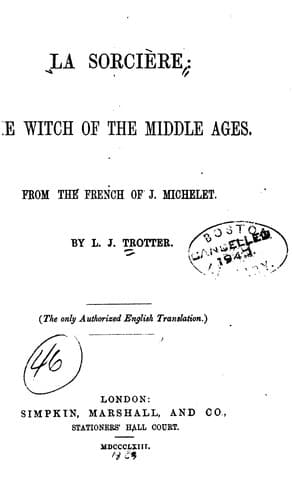
La Sorcière: The Witch of the Middle AgesMichelet, Jules
History
La Sorcière: The Witch of the Middle Ages
Michelet, Jules
Demonomania -- History -- To 1500; Satanism -- History -- To 1500; Superstition -- History -- To 1500; Witchcraft -- History -- To 1500
Lancre wrote his book mainly to show how much the justice of French
Parliaments and laymen excelled the justice of the priests. It is
written lightly, merrily, with flowing pen. It seems to express the
joy felt by one who has come creditably out of a great risk. It is a
gasconading, an over-boastful joy. He tells with pride how, the
Sabbath following the first execution of the witches, their children
went and wailed to Satan, who replied that their mothers had not been
burnt, but were alive and happy. From the midst of the crowd the
children thought they heard their mothers’ voices saying how
thoroughly blest they were. Satan was frightened nevertheless. He
absented himself for four Sabbaths, sending a small commonplace devil
in his stead. He did not show himself again till the 22nd July. When
the wizards asked him the reason of his absence, he said, “I have been
away, pleading your cause against _Little John_,” the name by which he
called Jesus. “I have won the suit, and they who are still in prison
will not be burnt.”
The lie was given to the great liar. And the conquering magistrate
avers that, while the last witch was burning, they saw a swarm of
toads come out of her head. The people fell on them with stones, so
that she was rather stoned than burnt. But for all their attacks, they
could not put an end to one black toad which escaped from flames,
sticks, and stones, to hide, like the Devil’s imp it was, in some spot
where it could never be found.[85]
[85] For a more detailed account of these Basque Witches, the
English reader may turn to Wright’s _Narratives of Sorcery
and Magic_. Bentley, 1851.--TRANS.
CHAPTER V.
SATAN TURNS PRIEST.
Whatever semblance of Satanic fanaticism was still preserved by the
witches, it transpires from the narratives of Lancre and other writers
of the seventeenth century, that the Sabbath then was mainly an affair
of money. They raised contributions almost by force, charged something
for right of entrance, and extracted fines from those who stayed away.
At Brussels and in Picardy, they had a fixed scale of payment for
rewarding those who brought new members into the brotherhood.
In the Basque country no mystery was kept up. The gatherings there
would amount to twelve thousand persons, of all classes, rich or poor,
priests and gentlemen. Satan, himself a gentleman, wore a hat upon his
three horns, like a man of quality. Finding his old seat, the druidic
stone, too hard for him, he treats himself to an easy well-gilt
arm-chair. Shall we say he is growing old? More nimble now than when
he was young, he frolics about, cuts capers, and leaps from the bottom
of a large pitcher. He goes through the service head downwards, his
feet in the air.
Public-domain text, read in full here on John Shaqi.
Reviews
Reviews
No reviews yet
Be the first to share your thoughts on this work.
Elsewhere in the archive
Join the Discussion
Join the discussion
Sign in to leave a comment or review.
Sign InorCreate an account