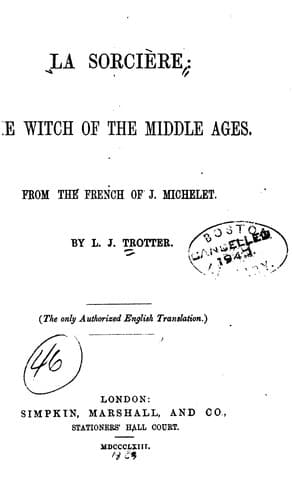
La Sorcière: The Witch of the Middle AgesMichelet, Jules
History
La Sorcière: The Witch of the Middle Ages
Michelet, Jules
Demonomania -- History -- To 1500; Satanism -- History -- To 1500; Superstition -- History -- To 1500; Witchcraft -- History -- To 1500
But the best physic for the conversion of Madeline was the death of
Gauffridi. On the 5th February, the inquisitor went to Aix for his
Lent preachings, saw the judges, and stirred them up. The Parliament,
swiftly yielding to such a pressure, sent off to Marseilles an order
to seize the rash man, who, finding himself so well backed by Bishop,
Chapter, Capuchins, and all the world, had fancied they would never
dare so far.
Madeline from one quarter, Gauffridi from another, arrived at Aix. She
was so disturbed that they were forced to bind her. Her disorder was
frightful, and all were in great perplexity what to do. They bethought
them at least of one bold way of dealing with this sick child; one of
those fearful tricks that throw a woman into fits, and sometimes kill
her outright. A vicar-general of the archbishopric said that the
palace contained a dark narrow charnel-house, such as you may see in
the Escurial, and called in Spain a “rotting vat.”
There, in olden days, old bones of unknown dead were left to waste
away. Into this tomb-like cave the trembling girl was led. They
exorcised her by putting those chilly bones to her face. She did not
die of fright, but thenceforth gave herself up to their will and
pleasure; and so they got what they wanted, the death of the
conscience, the destruction of all that remained to her of moral
insight and free will.
She became their pliant tool, ready to obey their least desire, to
flatter them, to try and guess beforehand what would give them most
pleasure. Huguenots were brought before her: she called them names.
Confronted with Gauffridi, she told forth by heart her grievances
against him, better than the King’s own officers could have done. This
did not prevent her from squalling violently, when she was brought to
the church to excite the people against Gauffridi, by making her devil
blaspheme in the magician’s name. Beelzebub speaking through her said,
“In the name of Gauffridi I abjure God;” and again, at the lifting up
of the Host, “Let the blood of the just be upon me, in the name of
Gauffridi!”
An awful fellowship indeed! This twofold devil condemns one out of the
other’s mouth; whatever Madeline says, is ascribed to Gauffridi. And
the scared crowd were impatient to behold the burning of the dumb
blasphemer, whose ungodliness so loudly declared itself by the voice
of the girl.
The exorcisers then put to her this cruel question, to which they
themselves could have given the best answer:--“Why, Beelzebub, do you
speak so ill of your great friend?” Her answer was frightful: “If
there be traitors among men, why not among demons also? When I am with
Gauffridi, I am his to do all his will. But when you constrain me, I
betray him and turn him to scorn.”
Public-domain text, read in full here on John Shaqi.
Reviews
Reviews
No reviews yet
Be the first to share your thoughts on this work.
Elsewhere in the archive
Join the Discussion
Join the discussion
Sign in to leave a comment or review.
Sign InorCreate an account