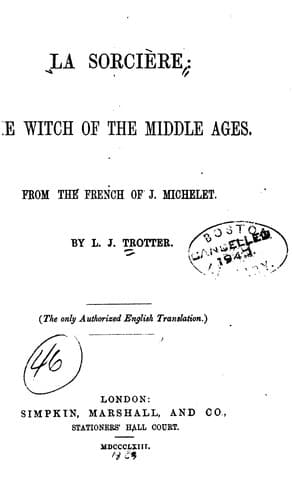
La Sorcière: The Witch of the Middle AgesMichelet, Jules
History
La Sorcière: The Witch of the Middle Ages
Michelet, Jules
Demonomania -- History -- To 1500; Satanism -- History -- To 1500; Superstition -- History -- To 1500; Witchcraft -- History -- To 1500
However, she could not keep up this hateful mockery. Though the demon
of fear and fawning seemed to have gotten fast hold of her, there was
room still for despair. She could no longer take the slightest food;
and they who for five months had been killing her with exorcisms and
pretending to relieve her of six or seven thousand devils, were fain
to admit that she longed only to die, and greedily sought after any
means of self-destruction. Courage alone was wanting to her. Once she
pricked herself with a lancet, but lacked the spirit to persevere.
Once she caught up a knife, and when that was taken from her, tried to
strangle herself. She dug needles into her body, and then made one
last foolish effort to drive a long pin through her ear into her head.
What became of Gauffridi? The inquisitor, who dwells so long on the
two women, says almost nothing about him. He walks as it were over
the fire. The little he does say is very strange. He relates that
having bound Gauffridi’s eyes, they pricked him with needles all over
the body, to find out the callous places where the Devil had made his
mark. On the removal of the bandage, he learned, to his horror and
amazement, that the needle had thrice been stuck into him without his
feeling it; so he was marked in three places with the sign of Hell.
And the inquisitor added, “If we were in Avignon, this man should be
burnt to-morrow.”
He felt himself a lost man; and defended himself no more. His only
thought now was to see if he could save his life through any of the
Dominicans’ foes. He wished, he said, to confess himself to the
Oratorians. But this new order, which might have been called the right
mean of Catholicism, was too cold and wary to take up a matter already
so hopeless and so far advanced.
Thereon he went back again to the Begging Friars, confessing himself
to the Capuchins, and acknowledging all and more than all the truth,
that he might purchase life with dishonour. In Spain he would
assuredly have been enlarged, barring a term of penance in some
convent. But our Parliaments were sterner: they felt bound to prove
the greater purity of the lay jurisdiction. The Capuchins, themselves
a little shaky in the matter of morals, were not the people to draw
the lightning down on their own body. They surrounded Gauffridi,
sheltered him, gave him comfort day and night; but only in order that
he might own himself a magician, and so, because magic formed the main
head of his indictment, the seduction wrought by a confessor to the
great discredit of the clergy might be left entirely in the
background.
So his friends the Capuchins, by dint of tender caresses and urgent
counsel, drew from him the fatal confession which, by their showing,
was to save his soul, but which was very certain to hand his body over
to the stake.
Public-domain text, read in full here on John Shaqi.
Reviews
Reviews
No reviews yet
Be the first to share your thoughts on this work.
Elsewhere in the archive
Join the Discussion
Join the discussion
Sign in to leave a comment or review.
Sign InorCreate an account