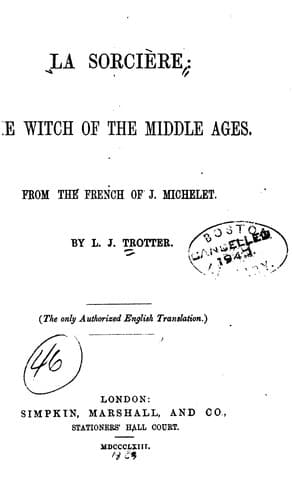
La Sorcière: The Witch of the Middle AgesMichelet, Jules
History
La Sorcière: The Witch of the Middle Ages
Michelet, Jules
Demonomania -- History -- To 1500; Satanism -- History -- To 1500; Superstition -- History -- To 1500; Witchcraft -- History -- To 1500
The wonder was, that the matter had not been sooner known. Having
spread so far, it could not have been wholly hidden. The Capuchins
swore that in Picardy alone, where the girls are weak and
warmer-blooded than in the South, this amorously mystic folly owned
some sixty thousand professors. Did all the clergy share in it--all
the confessors and directors? We must remember, that attached to the
official directors were a good many laymen, who glowed with the same
zeal for the souls of women. One of them, who afterwards made some
noise by his talent and boldness, is the author of _Spiritual
Delights_, Desmarets of Saint Sorlin.
* * * * *
Without remembering the new state of things, we should fail to
understand the all-powerful attitude of the director towards the nuns,
of whom he was now a hundred-fold more the master than he had been in
days of yore.
The reforming movement of the Council of Trent, for the better
enclosing of monasteries, was not much followed up in the reign of
Henry IV., when the nuns received company, gave balls, danced, and so
forth. In the reign, however, of Louis XIII., it began afresh with
greater earnestness. The Cardinal Rochefoucauld, or rather the Jesuits
who drew him on, insisted on a great deal of outward decency. Shall we
say, then, that all entrance into the convents was forbidden? One man
only went in every day, not only into the house, but also, if he
chose, into each of the cells; a fact made evident from several known
cases, especially that of David at Louviers. By this reform, this
closing system, the door was shut upon the world at large, on all
inconvenient rivals, while the director enjoyed the sole command of
his nuns, the special right of private interviews with them.
What would come of this? The speculative might treat it as a problem;
not so practical men or physicians. The physician Wyer tells some
plain stories to show what did come of it from the sixteenth century
onwards. In his Fourth Book he quotes a number of nuns who went mad
for love. And in Book III. he talks of an estimable Spanish priest
who, going by chance into a nunnery, came out mad, declaring that the
brides of Jesus were his also, brides of the priest, who was a vicar
of Jesus. He had masses said in return for the favour which God had
granted him in this speedy marriage with a whole convent.
If this was the result of one passing visit, we may understand the
plight of a director of nuns when he was left alone with them, and
could take advantage of the new restrictions to spend the day among
them, listening hour by hour to the perilous secret of their
languishings and their weaknesses.
Public-domain text, read in full here on John Shaqi.
Reviews
Reviews
No reviews yet
Be the first to share your thoughts on this work.
Elsewhere in the archive
Join the Discussion
Join the discussion
Sign in to leave a comment or review.
Sign InorCreate an account