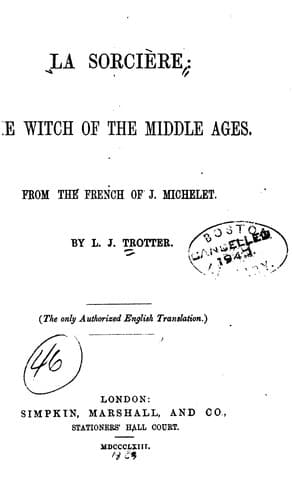
La Sorcière: The Witch of the Middle AgesMichelet, Jules
History
La Sorcière: The Witch of the Middle Ages
Michelet, Jules
Demonomania -- History -- To 1500; Satanism -- History -- To 1500; Superstition -- History -- To 1500; Witchcraft -- History -- To 1500
The name of the Dominicans, damaged by this trial, was not much
exalted by another case of _possession_ got up at Beauvais in such a
way as to ensure them all the honours of a war, the account of which
they got printed in Paris. Louisa’s devil having been reproached for
not speaking Latin, the new demoniac, Denise Lacaille, mingled a few
words of it in her gibberish. They made a plenty of noise about her,
often displayed her in the midst of a procession, and even carried her
from Beauvais to Our Lady of Liesse. But the matter kept quite cool.
This Picard pilgrimage lacked the horror, the dramatic force of the
affair at Sainte-Baume. This Lacaille, for all her Latin, had neither
the burning eloquence, nor the mettle, nor the fierce rage, that
marked the woman of Provence. The only end of all her proceedings was
to amuse the Huguenots.
What became of the two rivals, Madeline and Louisa? The former, or at
least her shadow, was kept on Papal ground, for fear of her being led
to speak about so mournful a business. She was never shown in public,
save in the character of a penitent. She was taken out among the poor
women to cut wood, which was afterwards sold for alms; the parents,
whom she had brought to shame, having forsworn and forsaken her.
Louisa, for her part, had said during the trial: “I shall make no
boast about it. The trial over, I shall soon be dead.” But this was
not to be. Instead of dying, she went on killing others. The
murdering devil within her waxed stormier than ever. She set about
revealing to the inquisitors the names, both Christian and surnames,
of all whom she fancied to have any dealings with magic; among others
a poor girl named Honoria, “blind of both eyes,” who was burnt alive.
“God grant,” says Father Michaëlis, in conclusion, “that all this may
redound to His own glory and to that of His Church!”
CHAPTER VII.
THE DEMONIACS OF LOUDUN--URBAN GRANDIER: 1632-1634.
In the _State Memoirs_, written by the famous Father Joseph, and known
to us by extracts only--the work itself having, no doubt, been wisely
suppressed as too instructive--the good Father explained how, in 1633,
he had the luck to discover a heresy, a huge heresy, in which ever so
many confessors and directors were concerned. That excellent army of
Church-constables, those dogs of the Holy Troop, the Capuchins, had,
not only in the wildernesses, but even in the populous parts of
France--at Chartres, in Picardy, everywhere--got scent of some
dreadful game; the _Alumbrados_ namely, or Illuminate, of Spain, who
being sorely persecuted there, had fled for shelter into France,
where, in the world of women, especially among the convents, they
dropped the gentle poison which was afterwards called by the name of
Molinos.[90]
[90] Molinos, born at Saragossa in 1627, died a prisoner to
the Inquisition in 1696. His followers were called
Quietists.--TRANS.
Public-domain text, read in full here on John Shaqi.
Reviews
Reviews
No reviews yet
Be the first to share your thoughts on this work.
Elsewhere in the archive
Join the Discussion
Join the discussion
Sign in to leave a comment or review.
Sign InorCreate an account