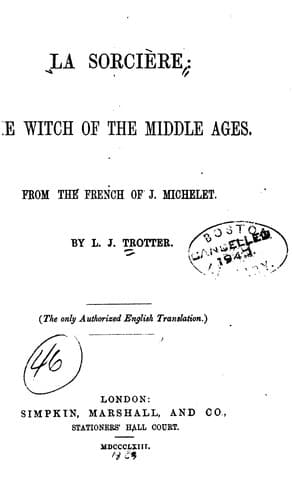
La Sorcière: The Witch of the Middle AgesMichelet, Jules
History
La Sorcière: The Witch of the Middle Ages
Michelet, Jules
Demonomania -- History -- To 1500; Satanism -- History -- To 1500; Superstition -- History -- To 1500; Witchcraft -- History -- To 1500
In order to see a little more clearly, we must not set Grandier by
himself; we must keep his place in the devilish trilogy of those
times, in which he figured only as a second act; we must explain him
by the first act, already shown to us in the dreadful business of
Sainte-Baume, and the death of Gauffridi; we must explain him by the
third act, by the affair at Louviers, which copied Loudun, as Loudun
had copied Sainte-Baume, and which in its turn owned a Gauffridi and
an Urban Grandier.
The three cases are one and selfsame. In each case there is a
libertine priest, in each a jealous monk, and a frantic nun by whose
mouth the Devil is made to speak; and in all three the priest gets
burnt at last.
And here you may notice one source of light which makes these matters
clearer to our eyes than if we saw them through the miry shades of a
monastery in Spain or Italy. In those lands of Southern laziness, the
nuns were astoundingly passive, enduring the life of the seraglio and
even worse.[93] Our French women, on the contrary, gifted with a
personality at once strong, lively, and hard to please, were equally
dreadful in their jealousy and in their hate; and being devils indeed
without metaphor, were accordingly rash, blusterous, and prompt to
accuse. Their revelations were very plain, so plain indeed at the
last, that everyone felt ashamed; and after thirty years and three
special cases, the whole thing, begun as it was through terror, got
fairly extinguished in its own dulness beneath hisses of general
disgust.
[93] See Del Rio, Llorente Ricci, &c.
It was not in Loudun, amidst crowds of Poitevins, in the presence of
so many scoffing Huguenots, in the very town where they held their
great national synods, that one would have looked for an event so
discreditable to the Catholics. But these latter, living, as it were,
in a conquered country,[94] in the old Protestant towns, with the
greatest freedom, and thinking, not without cause, of the people they
had often massacred and but lately overcome, were not the persons to
say a word about it. Catholic Loudun, composed of magistrates,
priests, monks, a few nobles, and some workmen, dwelled aloof from the
rest, like a true conquering settlement. This settlement, as one might
easily guess, was rent in twain by the rivalry of the priests and the
monks.
[94] The capture of Rochelle, the last of the Huguenot
strongholds took place in 1628.--TRANS.
* * * * *
Public-domain text, read in full here on John Shaqi.
Reviews
Reviews
No reviews yet
Be the first to share your thoughts on this work.
Elsewhere in the archive
Join the Discussion
Join the discussion
Sign in to leave a comment or review.
Sign InorCreate an account