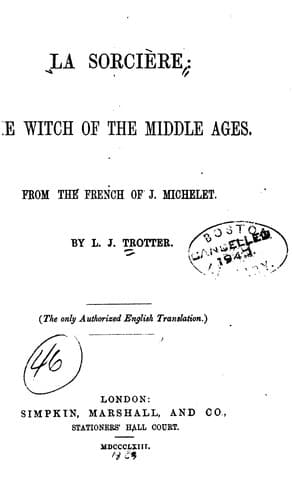
La Sorcière: The Witch of the Middle AgesMichelet, Jules
History
La Sorcière: The Witch of the Middle Ages
Michelet, Jules
Demonomania -- History -- To 1500; Satanism -- History -- To 1500; Superstition -- History -- To 1500; Witchcraft -- History -- To 1500
The monks, being numerous and proud, as men specially sent forth to
make converts, kept the pick of the pavement against the Protestants,
and were confessing the Catholic ladies, when there arrived from
Bordeaux a young vicar, brought up by the Jesuits, a man of letters,
of pleasing manners, who wrote well and spoke better. He made a noise
in the pulpit, and ere long in the world. By birth a townsman of
Mantes, of a wrangling turn, he was Southern by education, with all
the readiness of a Bordelais, boastful and frivolous as a Gascon. He
soon managed to set the whole town by the ears, drawing the women to
his side, while the men were mostly against him. He became lofty,
insolent, unbearable, devoid of respect for everything. The Carmelites
he overwhelmed with jibes; he would rail away from his pulpit against
monks in general. They choked with rage at his sermons. Proud and
stately, he went along the streets of Loudun like a Father of the
Church; but by night he would steal, with less of bluster, down the
byeways and through back-doors.
They all surrendered themselves to his pleasure. The wife of the Crown
Counsel was aware of his charms; still more so the daughter of the
Public Prosecutor, who had a child by him. This did not satisfy him.
Master of the ladies, this conqueror pushed his advantage until he had
gained the nuns.
By that time the Ursulines abounded everywhere, sisters devoted to
education, feminine missionaries in a Protestant land, who courted and
pleased the mothers, while they won over the little girls. The nuns of
Loudun formed a small convent of young ladies, poor and well-born. The
convent in itself was poor, the nuns for whom it was founded, having
been granted nothing but their house, an old Huguenot college. The
prioress, a lady of good birth and high connections, burned to exalt
her nunnery, to enlarge it, make it wealthier and wider known. Perhaps
she would have chosen Grandier, as being then the fashion, had she not
already gotten for her director a priest with very different rootage
in the country, a near kinsman of the two chief magistrates. The
Canon Mignon, as he was called, held the prioress fast. These two were
enraged at learning through the confessional--the “Ladies Superior”
might confess their nuns--that the young nuns dreamed of nothing but
this Grandier, of whom there was so much talk.
Thereupon three parties, the threatened director, the cheated husband,
the outraged father, joined together by a common jealousy, swore
together the destruction of Grandier. To ensure success, they only
needed to let him go on. He was ruining himself quite fast enough. An
incident that came to light made noise enough almost to bring down the
town.
* * * * *
Public-domain text, read in full here on John Shaqi.
Reviews
Reviews
No reviews yet
Be the first to share your thoughts on this work.
Elsewhere in the archive
Join the Discussion
Join the discussion
Sign in to leave a comment or review.
Sign InorCreate an account