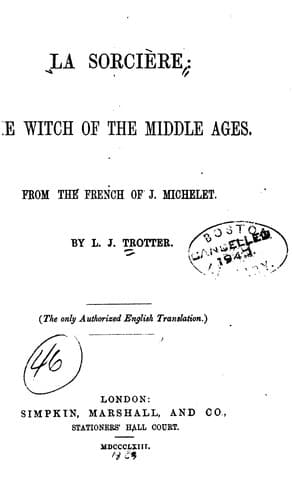
La Sorcière: The Witch of the Middle AgesMichelet, Jules
History
La Sorcière: The Witch of the Middle Ages
Michelet, Jules
Demonomania -- History -- To 1500; Satanism -- History -- To 1500; Superstition -- History -- To 1500; Witchcraft -- History -- To 1500
Was there nought else, then, but laughter and jesting? Nay, it was the
Advent of Reason. By means of Kepler, of Galileo, Descartes, Newton,
there was now triumphantly enthroned the reasonable dogma of faith in
the unchangeable laws of nature. Miracle dared no longer show itself,
or, when it did dare, was hissed down. In other and better words, the
fantastic miracles of mere whim had vanished, and in their stead was
seen the mighty miracle of the universe--more regular, and therefore
more divine.
The great rebellion decidedly won the day. You may see it working in
the bold forms of those earlier outbursts; in the irony of Galileo; in
the absolute doubt wherewith Descartes leads off his system. The
Middle Ages would have said, “’Tis the spirit of the Evil One.”
The victory, however, is not a negative one, but very affirmative and
surely based. The spirit of nature and the natural sciences, those
outlaws of an elder day, return in might irresistible. All idle
shadows are hunted out by the real, the substantial.
They had said in their folly, “Great Pan is dead.” Anon, observing
that he was yet alive, they had made him a god of evil: amid such a
chaos they might well be deceived. But, lo! he lives, and lives
harmonious, in the grand stability of laws that govern alike the star
and the deep-hidden mystery of life.
* * * * *
Of this period two things, by no means contradictory, may be averred:
the spirit of Satan conquers, while the reign of witchcraft is at an
end.
All marvel-mongering, hellish or holy, is fallen very sick at last.
Wizards and theologians are powerless alike. They are become, as it
were, empirics, who pray in vain for some supernatural change, some
whim of Providence, to work the wonders which science asks of nature
and reason only.
For all their zeal, the Jansenists of this century succeed only in
bringing forth a miracle very small and very ridiculous. Still less
lucky are the rich and powerful Jesuits, who cannot get a miracle done
at any price; who have to be satisfied with the visions of a hysteric
girl, Sister Mary Alacoque, of an exceedingly sanguine habit, with
eyes for nothing but blood. In view of so much impotence, magic and
witchcraft may find some solace for themselves.
While the old faith in the supernatural was thus declining, priests
and witches shared a common fate. In the fears, the fancies of the
Middle Ages, these two were bound up together. Together they were
still to face the general laughter and disdain. When Molière made fun
of the Devil and his “seething cauldrons,” the clergy were deeply
stirred, deeming that the belief in Paradise had fallen equally low.
Public-domain text, read in full here on John Shaqi.
Reviews
Reviews
No reviews yet
Be the first to share your thoughts on this work.
Elsewhere in the archive
Join the Discussion
Join the discussion
Sign in to leave a comment or review.
Sign InorCreate an account