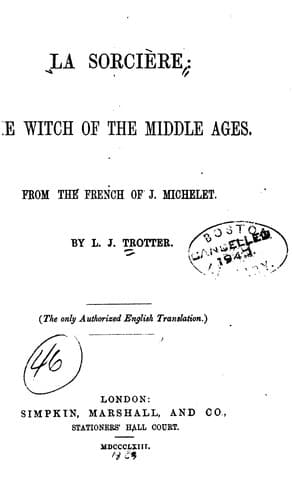
La Sorcière: The Witch of the Middle AgesMichelet, Jules
History
La Sorcière: The Witch of the Middle Ages
Michelet, Jules
Demonomania -- History -- To 1500; Satanism -- History -- To 1500; Superstition -- History -- To 1500; Witchcraft -- History -- To 1500
A government of laymen only, that of the great Colbert, who was long
the virtual King of France, could not conceal its scorn for such old
questions. It emptied the prisons of the wizards whom the Rouen
Parliament still crowded into them, and, in 1672, forbade the law
courts from entertaining any prosecutions for witchcraft. The
Parliament protested, and gave people to understand that by this
denial of sorcery many other things were put in peril. Any doubting of
these lower mysteries would cause many minds to waver from their
belief in mysteries of a higher sort.
* * * * *
The Sabbath disappears, but why? Because it exists everywhere. It
enters into the people’s habits, becomes the practice of their daily
life. The Devil, the Witches, had long been reproached with loving
death more than life, with hating and hindering the generative powers
of nature. And now in the pious seventeenth century, when the Witch is
fast dying out, a love of barrenness, and a fear of being fruitful,
are found to be, in very truth, the one prevalent disease.
If Satan ever read, he would have good cause for laughter as he read
the casuists who took him up where he left off. For there was one
difference at least between them. In times of terror Satan made
provision for the famished, took pity on the poor. But these fellows
have compassion only for the rich. With his vices, his luxury, his
court life, the rich man is still a needy miserable beggar. He comes
to confession with a humbly threatening air, in order to wrest from
his doctor permission to sin with a good conscience. Some day will be
told, by him who may have the courage to tell it, an astounding tale
of the cowardly things done, and the shameful tricks so basely
ventured by the casuist who wished to keep his penitent. From Navarro
to Escobar the strangest bargains were continually made at the wife’s
expense, and some little wrangling went on after that. But all this
would not do. The casuist was conquered, was altogether a coward. From
Zoccoli to Liguori--1670 to 1770--he gave up banning Nature.
The Devil, so it was said, showed two countenances at the Sabbath: the
one in front seemed threatening, the other behind was farcical. Now
that he has nothing to do with it, he has generously given the latter
to the casuist.
Public-domain text, read in full here on John Shaqi.
Reviews
Reviews
No reviews yet
Be the first to share your thoughts on this work.
Elsewhere in the archive
Join the Discussion
Join the discussion
Sign in to leave a comment or review.
Sign InorCreate an account