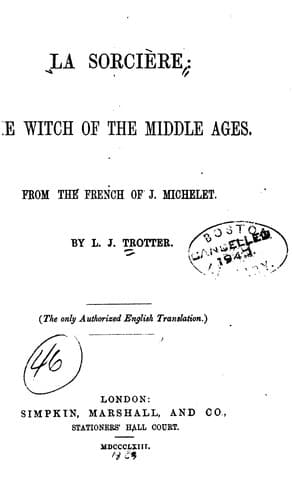
La Sorcière: The Witch of the Middle AgesMichelet, Jules
History
La Sorcière: The Witch of the Middle Ages
Michelet, Jules
Demonomania -- History -- To 1500; Satanism -- History -- To 1500; Superstition -- History -- To 1500; Witchcraft -- History -- To 1500
Such also was the punishment awarded the famous Jesuit, Girard, who
was loaded with honours when he should have got the rope. He died in
the sweetest savour of holiness. His was the most curious affair of
that century. It enables us to probe the peculiar methods of that day,
to realize the coarse jumble of jarring machinery which was then at
work. As a thing of course, it was preluded by the dangerous suavities
of the Song of Songs. It was carried on by Mary Alacoque, with a
marriage of Bleeding Hearts spiced with the morbid blandishments of
Molinos. To these Girard added the whisperings of Satan and the
terrors of enchantment. He was at once the Devil and the Devil’s
exorciser. At last, horrible to say, instead of getting justice done
to her, the unhappy girl whom he sacrificed with so much cruelty, was
persecuted to death. She disappeared, shut up perhaps by a _lettre de
cachet_, and buried alive in her tomb.
CHAPTER X.
FATHER GIRARD AND LA CADIERE: 1730.
The Jesuits were unlucky. Powerful at Versailles, where they ruled the
Court, they had not the slightest credit with Heaven. Not one tiny
miracle could they do. The Jansenists overflowed, at any rate, with
touching stories of miracles done. Untold numbers of sick, infirm,
halt, and paralytic obtained a momentary cure at the tomb of the
Deacon Pâris. Crushed by a terrible succession of plagues, from the
time of the Great King to the Regency, when so many were reduced to
beggary, these unfortunate people went to entreat a poor, good fellow,
a virtuous imbecile, a saint in spite of his absurdities, to make them
whole. And what need, after all, of laughter? His life is far more
touching than ridiculous. We are not to be surprised if these good
folk, in the emotion of seeing their benefactor’s tomb, suddenly
forgot their own sufferings. The cure did not last, but what matter? A
miracle indeed had taken place, a miracle of devotion, of
lovingkindness, of gratitude. Latterly, with all this some knavery
began to mingle, but at that time, in 1728, these wonderful popular
scenes were very pure.
The Jesuits would have given anything for the least of the miracles
they denied. For well-nigh fifty years they worked away, embellishing
with fables and anecdotes their Legend of the Sacred Heart, the story
of Mary Alacoque. For twenty-five or thirty years they had been trying
to convince the world that their helpmate, James II. of England, not
content with healing the king’s evil (in his character of King of
France), amused himself after his death in making the dumb to speak,
the lame to walk straight, and the squint-eyed to see properly. They
who were cured squinted worse than ever. As for the dumb, it so
chanced that she who played this part was a manifest rogue, caught in
the very act of stealing. She roamed the provinces: at every chapel of
any renowned saint she was healed by a miracle and received alms, and
then began her work again elsewhere.
Public-domain text, read in full here on John Shaqi.
Reviews
Reviews
No reviews yet
Be the first to share your thoughts on this work.
Elsewhere in the archive
Join the Discussion
Join the discussion
Sign in to leave a comment or review.
Sign InorCreate an account