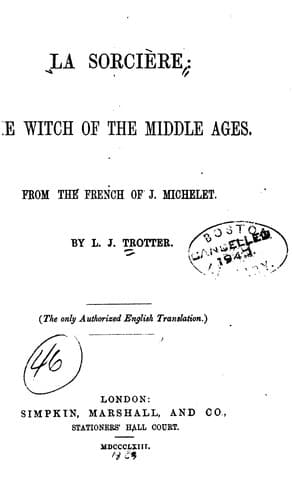
La Sorcière: The Witch of the Middle AgesMichelet, Jules
History
La Sorcière: The Witch of the Middle Ages
Michelet, Jules
Demonomania -- History -- To 1500; Satanism -- History -- To 1500; Superstition -- History -- To 1500; Witchcraft -- History -- To 1500
This is too sweeping a reduction of the question. Satan was more than
that. The doctors saw neither the height nor the depth of him; neither
his grand revolt in the form of science, nor that strange mixture of
impurity and pious intrigue, that union of Tartuffe and Priapus, which
he brought to pass about the year 1700.
People fancy they know something about the eighteenth century, and
yet have never seen one of its most essential features. The greater
its outward civilization, the clearer and fuller the light that bathed
its uppermost layers, so much the more hermetically sealed lay all
those widespread lower realms, of priests and monks, and women
credulous, sickly, prone to believe whatever they heard or saw. In the
years before Cagliostro, Mesmer, and the magnetisers, who appeared
towards the close of the century, a good many priests still worked
away at the old dead witchcraft. They talked of nothing but
enchantments, spread the fear of them abroad, and undertook to hunt
out the devils with their shameful exorcisms. Many set up for wizards,
well knowing how little risk they ran, now that people were no longer
burnt. They knew they were sheltered by the milder spirit of their
age, by the tolerant teachings of their foes the philosophers, by the
levity of the great jesters, who thought that anything could be
extinguished with a laugh. Now it was just because people laughed,
that these gloomy plot-spinners went their way without much fear. The
new spirit, that of the Regent namely, was sceptical and easy-natured.
It shone forth in the _Persian Letters_, it shone forth everywhere in
the all-powerful journalist who filled that century, Voltaire. At any
shedding of human blood his whole heart rises indignant. All other
matters only make him laugh. Little by little, the maxim of the
worldly public seems to be, “Punish nothing, and laugh at all.”
This tolerant spirit suffered Cardinal Tencin to appear in public as
his sister’s husband. This, too, it was that ensured to the masters of
convents the peaceful possession of their nuns, who were even allowed
to make declarations of pregnancy, to register the births of their
children.[106] This tolerant temper made excuses for Father
Apollinaire, when he was caught in a shameful piece of exorcism. That
worthy Jesuit, Cauvrigny, idol of the provincial convents, paid for
his adventures only by a recall to Paris, in other words--by fresh
preferment.
[106] The noble Chapter of Canons of Pignan were sixteen in
number. In one year the provost received from the nuns
sixteen declarations of pregnancy. (See MS. History of Besse,
by M. Renoux.) One good fruit of this publicity was the
decrease of infanticide among the religious orders. At the
price of a little shame, the nuns let their children live,
and doubtless became good mothers. Those of Pignan put their
babes out to nurse with the neighbouring peasants, who
brought them up as their own.
Public-domain text, read in full here on John Shaqi.
Reviews
Reviews
No reviews yet
Be the first to share your thoughts on this work.
Elsewhere in the archive
Join the Discussion
Join the discussion
Sign in to leave a comment or review.
Sign InorCreate an account