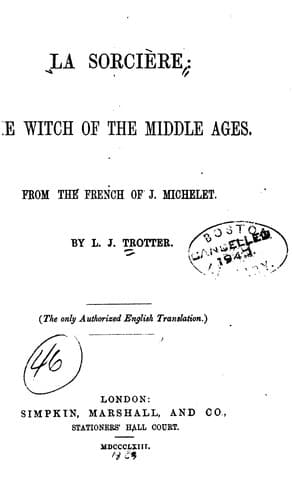
La Sorcière: The Witch of the Middle AgesMichelet, Jules
History
La Sorcière: The Witch of the Middle Ages
Michelet, Jules
Demonomania -- History -- To 1500; Satanism -- History -- To 1500; Superstition -- History -- To 1500; Witchcraft -- History -- To 1500
The great lords of that day, being fond of having children and little
pages to wait on them, readily took in the better-mannered of their
peasant’s sons. In this way had the bishop dealt with the boy of one
of his tenants. He washed his face, as it were; made him tidy.
Presently, when the favourite grew up, he gave him the tonsure,
dressed him up like an abbé, and dubbed him his chaplain at the age of
twenty. This person was the Abbé Camerle. Brought up with the footmen
and made to do everything, he was, like many a half-scrubbed country
youth, a sly, but simple lout. He saw that the prelate since his
arrival at Toulon had been curious about Cadière and far from friendly
to Girard. He thought to please and amuse his master by turning
himself, at Ollioules, into a spy on their suspected intercourse. But
after the bishop changed through fear of the Jesuits, Camerle became
equally zealous in helping Girard with active service against Cadière.
He came one day, like another Joseph, to say that Mdlle. Cadière had,
like Potiphar’s wife, been tempting him, and trying to shake his
virtue. Had this been true, it was all the more cowardly of him thus
to punish her for a moment’s weakness, to take so mean an advantage of
some light word. But his education as page and seminarist was not such
as to bring him either honour or the love of women.
She extricated herself with spirit and success, covering him with
shame. The two angry commissioners saw her making so triumphant an
answer, that they cut the investigation short, and cut down the number
of her witnesses. Out of the sixty-eight she summoned, they allowed
but thirty-eight to appear. Regardless alike of the delays and the
forms of justice, they hurried forward the confronting of witnesses.
Yet nothing was gained, thereby. On the 25th and again on the 26th
February, she renewed her crushing declarations.
Such was their rage thereat, that they declared their regret at the
want of torments and executioners in Toulon, “who might have made her
sing out a little.” These things formed their _ultima ratio_. They
were employed, by the Parliaments through all that century. I have
before me a warm defence of torture,[114] written in 1780, by a
learned member of Parliament, who also became a member of the Great
Council; it was dedicated to the King, Louis XVI., and crowned with
the flattering approval of His Holiness Pius VI.
[114] Muyart de Vouglans, in the sequel to his _Loix
Criminelles_, 1780.
Public-domain text, read in full here on John Shaqi.
Reviews
Reviews
No reviews yet
Be the first to share your thoughts on this work.
Elsewhere in the archive
Join the Discussion
Join the discussion
Sign in to leave a comment or review.
Sign InorCreate an account