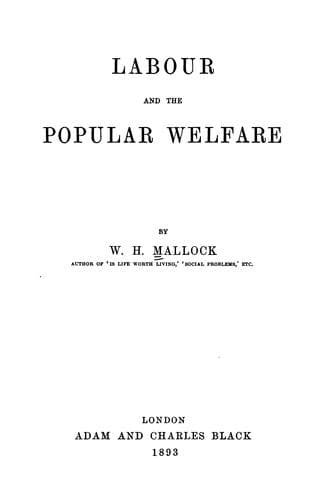
Labour and the Popular WelfareMallock, W. H. (William Hurrell)
General
Labour and the Popular Welfare
Mallock, W. H. (William Hurrell)
Labor; Labor movement; Socialism; Working class
Dreams of some possible social revolution, dreams of some division of
property by which most of the riches of the rich should be abstracted
from them and divided amongst the poor—these were not wanting fifty
years ago. ◆¹ But even the most sanguine of the dreamers hardly
ventured to hope that the then riches of the rich could be taken
away from them completely; that a sum equal to the rent of the whole
landed aristocracy, all the interest on Capital, all the profits of
our commerce and manufactures, could be added to what was then the
income of the labouring classes. No forces of revolution were thought
equal to such a change as that. But what have the facts been? What has
happened really? Within fifty years the miracle has taken place, or,
indeed, one greater than that. The same number of labourers and their
families as then formed the whole labouring population of the country
now possess among them every penny of the amount that then formed the
income of the entire nation. They have gained every penny that they
possibly could have gained if every rich man of that period—if duke,
and cotton lord, and railway king, followed by all the host of minor
plutocrats, had been forced to cast all they had into the treasury
of Labour, and give their very last farthing to swell the labourer’s
wages. The labourers have gained this; but that is not all. They have
gained an annual sum of _forty-seven million pounds_ more. And they
have done all this, not only without revolution, but without any
attack on the fundamental principles of property. On the contrary, the
circumstances which have enabled Labour to gain most from the proceeds
of Ability, have been the circumstances which have enabled Ability to
produce most itself.
[Sidenote ◆1 But before proceeding with this argument, there are
two side points to dispose of.]
◆¹ Before, however, we pursue these considerations further, it is
necessary that we should deal with two important points which have
perhaps already suggested themselves to the reader as essential to the
problem before us. They are not new points. They have been discussed in
previous chapters; but the time has now arrived to turn to them once
again.
CHAPTER II
_Of the Ownership of Capital, as distinct from its
Employment by Ability._
[Sidenote ◆1 In the foregoing argument, all mention of Land has
been omitted, for simplicity’s sake.]
[Sidenote ◆2 But rent, especially the rent of the large owners, is
so small a part of the national income that the omission
is of no practical importance.]
Public-domain text, read in full here on John Shaqi.
Reviews
Reviews
No reviews yet
Be the first to share your thoughts on this work.
Elsewhere in the archive
Join the Discussion
Join the discussion
Sign in to leave a comment or review.
Sign InorCreate an account