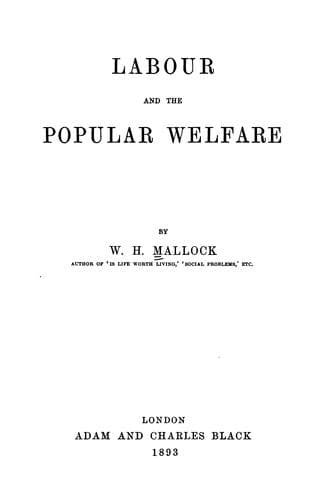
Labour and the Popular WelfareMallock, W. H. (William Hurrell)
General
Labour and the Popular Welfare
Mallock, W. H. (William Hurrell)
Labor; Labor movement; Socialism; Working class
The first of the points I have alluded to can be disposed of very
quickly. It relates to Land. In analysing the causes to which our
national income is due, I began with showing that Land produced a
certain definite part of it. ◆¹ For the sake, however, of simplicity,
in the calculation which I went on to make, I ignored Land, and the
fact of its being a productive agent; and treated the whole income as
if produced by Labour, Capital, and Ability. I wish, therefore, now to
point out to the reader that this procedure has had little practical
effect on the calculation in question, and that any error introduced
by it can be easily rectified in a moment. ◆² The entire landed rental
of this country is, as I have already shown, not so much as one
thirteenth of the income; whilst that of the larger landed proprietors
is not so much as one thirty-ninth. Now my sole object in dealing with
the national income at all is to show how far it is susceptible of
redistribution; and it is perfectly certain that no existing political
party would attempt, or even desire, to redistribute the rents of any
class except the large proprietors only. The smaller proprietors,—_nine
hundred and fifty thousand_ in number,—who take between them two-thirds
of the rental, are in little immediate danger of having their rights
attacked. The only rental therefore—namely, that of the larger
proprietors—which can be looked on, even in theory, as the subject of
redistribution, is too insignificant, being less than _thirty million
pounds_, to appreciably affect our calculations when we are dealing
with _thirteen hundred millions_. The theory of Land as an independent
productive agent, and of rent as representing its independent product,
is essential to an understanding of the theory of production generally;
but in this country the actual product of the Land is so small, as
compared with the products of Labour, Capital, and Ability, that for
purposes like the present it is hardly worth considering. Its being
redistributed, or not redistributed, would, as we have seen already,
make to each individual but a difference of three farthings a day.
[Sidenote ◆1 Capital, as distinct from the Ability that uses it,
has been omitted also.]
[Sidenote ◆2 We must now again consider it in connection with the
classes which never themselves employ it, but live on
the interest of it.]
[Sidenote ◆3 What place do these classes hold in the productive
system?]
Public-domain text, read in full here on John Shaqi.
Reviews
Reviews
No reviews yet
Be the first to share your thoughts on this work.
Elsewhere in the archive
Join the Discussion
Join the discussion
Sign in to leave a comment or review.
Sign InorCreate an account