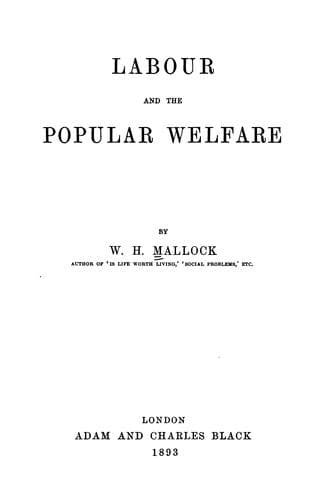
Labour and the Popular WelfareMallock, W. H. (William Hurrell)
General
Labour and the Popular Welfare
Mallock, W. H. (William Hurrell)
Labor; Labor movement; Socialism; Working class
Such, reduced to its simplest elements, is the process on which the
riches of the rich in the modern world depend. ◆¹ It will be seen,
however, that in the case we have just supposed, the labourers, by the
process in question, gain absolutely nothing. Each of them originally
made _fifty pounds_ a year. He now receives the same sum in wages. But
the total product has increased by _three hundred and fifty pounds_,
and of this the labourers acquire no share whatever. Nor, supposing
them to be inexperienced in the art of combination, is there any means
by which they could ever do so. And if our imaginary community were a
complete representation of reality, the same would be the case with the
labourers in real life.
[Sidenote ◆1 But let us introduce a second man of Ability
competing with the first, and the process of
distribution of the increased product amongst the
labourers begins at once.]
◆¹ But it must now be pointed out that in one important respect, as a
representation of reality, our community is incomplete. It represents
the main process by which the riches of the rich are produced; but it
offers no parallel to one factor in the real situation, owing to which
the labourers inevitably acquire a share in them. In that community the
rich classes are represented by a single person, who has no conflicting
interests analogous to his own to contend against. But in actual
life, so far as this point is concerned, the condition of the rich is
different altogether. As looked at from without, they are, indeed, a
single body, which may with accuracy be represented as one man; but
as looked at from within, they are a multitude of different bodies,
whose interests, within certain limits, are diametrically opposed to
each other. In order, therefore, to make our illustration complete,
instead of one man of Ability we must imagine two. The first, whose
fortunes we have just followed, and whom, for the sake of distinctness,
we will christen John, has already brought production to the state
that has been just described. He has managed to get seven men out of
eight to produce luxuries for himself,—luxuries, we will say, such
as wine, cigars, and butter,—paying these seven men with the surplus
necessaries which, with his assistance, are produced by the eighth man.
But of these luxuries the seven men keep none; nor can they give any
of them to the eighth man, their fellow. John takes all. But now let
us suppose that a second man of Ability, whom we will christen James,
appears upon the scene, just as anxious as John to direct Labour by
his Ability, and just as capable of making Labour productive. But all
the labourers are at present in the pay of John. James therefore must
set himself to detach them from John’s service; and he accordingly
engages that if they will work for him they shall not only each receive
the necessaries that John gives them, but a share of the other things
Public-domain text, read in full here on John Shaqi.
Reviews
Reviews
No reviews yet
Be the first to share your thoughts on this work.
Elsewhere in the archive
Join the Discussion
Join the discussion
Sign in to leave a comment or review.
Sign InorCreate an account