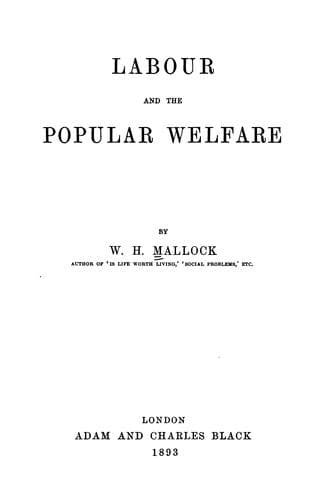
Labour and the Popular WelfareMallock, W. H. (William Hurrell)
General
Labour and the Popular Welfare
Mallock, W. H. (William Hurrell)
Labor; Labor movement; Socialism; Working class
that they produce—of the butter, of the cigars, and of the wine—as
well. The moment this occurs, John has to make a similar offer; and
thus the wages of Labour at once begin to rise. When they have been
forced up to a certain point, James and John cease to bid against one
another, and each employs a certain number of labourers, till one or
other of them makes some new discovery which enables the same amount
of some commodity—we will say cigars—as has hitherto been produced by
two men, to be produced by one; and thus a new labourer is set free,
and is available for some new employment. We must assume that James and
John could both employ this man profitably—that is, that they could
set him to produce some new object of desire—let us say strawberries;
and, this being so, there is again a competition for his labour. He
is offered by both employers as much as he has received hitherto, and
as the other labourers receive; and he is offered besides a certain
number of strawberries. Whichever employer ultimately secures his
services, the man has secured some further addition to his income. He
has some share in the increasing wealth of the community; and, as John
and James continue to compete in increasing the production of all other
commodities, some share of each increase will in time go to all the
labourers.
[Sidenote ◆1 And nothing can stop this process except an increase
of population _in excess of the increase_ in the
productive powers of Ability.]
Public-domain text, read in full here on John Shaqi.
Reviews
Reviews
No reviews yet
Be the first to share your thoughts on this work.
Elsewhere in the archive
Join the Discussion
Join the discussion
Sign in to leave a comment or review.
Sign InorCreate an account