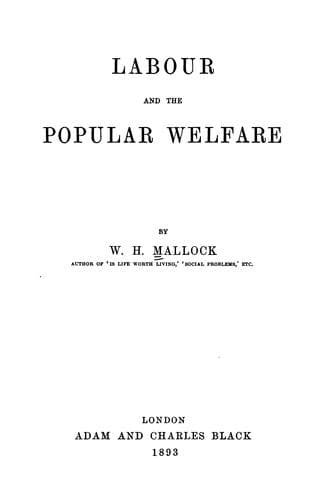
Labour and the Popular WelfareMallock, W. H. (William Hurrell)
General
Labour and the Popular Welfare
Mallock, W. H. (William Hurrell)
Labor; Labor movement; Socialism; Working class
◆¹ One thing only could interfere with this process; and that has
been excluded from our supposed community: namely, an increase in its
numbers. And a mere increase in the numbers would in itself not be
enough. It must be an increase which outstrips the discovery of new
ways in which labour may be employed profitably. Let us suppose that
to our original eight labourers, eight new labourers are added, who
if left to themselves could do just what the first eight could do,
namely, produce annual subsistence for themselves to the value of
_fifty pounds_ each. If, under the management of James or John, the
productivity of these men could be multiplied eight-fold, as was the
case with the first eight, James and John would be soon competing for
their services, and the second eight, like the first eight, would share
in the increased product. But if, owing to all the best land being
occupied, and few improvements having been discovered in the methods of
any new industries, the productivity of the new men could be increased
not eight-fold, but only by one-eighth—that is to say, if what each man
produces by his unaided Labour could be raised by Ability from _fifty
pounds_, not to _four hundred pounds_, but to no more than _fifty-six
pounds ten shillings_,—_fifty-six pounds ten shillings_ would be the
utmost these men would get, even if the Ability of James or John got
no remuneration whatever. Meanwhile, however, the first set of workmen
are, as we have seen, receiving much more than this. They are receiving
each, we will say, _one hundred pounds_. The second set, therefore,
naturally envy them their situations, and endeavour to secure these
for themselves by offering their Labour at a considerably lower price.
They offer it at _ninety pounds_, at _seventy pounds_, or even at
_sixty pounds_; for they would be bettering their present situation by
accepting even this last sum. This being the case, the original eight
labourers have necessarily to offer their Labour at reduced terms also;
and thus the wages of Labour are diminished all round.
Public-domain text, read in full here on John Shaqi.
Reviews
Reviews
No reviews yet
Be the first to share your thoughts on this work.
Elsewhere in the archive
Join the Discussion
Join the discussion
Sign in to leave a comment or review.
Sign InorCreate an account