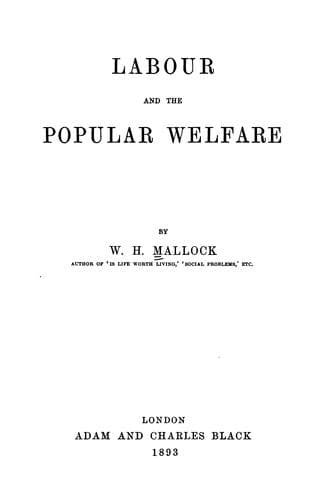
Labour and the Popular WelfareMallock, W. H. (William Hurrell)
General
Labour and the Popular Welfare
Mallock, W. H. (William Hurrell)
Labor; Labor movement; Socialism; Working class
[Sidenote ◆1 The operation of Trade Unionism in raising wages can
be easily seen at a glance by reference to the simple
community which was imagined in the last chapter.]
◆¹ If the reader has not already forgotten our imaginary community,—our
eight labourers with John and James directing them,—our easiest
course will be to turn again to that. We saw that when the labourers
were employed by John only,—John who found them each making _fifty
pounds_ a year, and enabled them by his Ability each to make _four
hundred pounds_—we saw that the whole of this increase, in the natural
course of things, would be kept by John himself, by whose Ability it
was practically created; for it would not be to John’s advantage to
part with any of it, and the labourers, so long as they all acted
separately, would have no means of extracting any of it from him. It
would be useless for one of them at a time to strike for higher wages.
The striker and the employer would meet on wholly unequal terms;
because the striker, whilst the strike lasted, would be sacrificing the
whole of his income, whilst depriving the employer of only an eighth
part of his. But let us alter the supposition. Let us suppose that
the labourers combine together, and that the whole eight strike for
higher wages simultaneously. The situation is now completely changed;
and the loss that the struggle will entail on both parties is equal.
The employer, like the labourer, will for a time lose all his income.
It is true that if the employer has a reserve fund on which he can
support himself whilst production is suspended, and if the labourer has
no such fund, the employer may still be sure of an immediate victory,
should he be resolved at all costs to resist the labourers’ demand.
But, in any case, the cost of resisting it will be appreciable: it is
a loss which the labourers will be able to inflict on him repeatedly;
and he may see that they would be able, by their strikes, to make him
ultimately lose more than he would by assenting to their demands, or,
at all events, making some concessions to them. It is therefore obvious
that the labourers, in such a case, will be able to extract extra wages
in the inverse proportion to the loss which the employer will sustain
if he concedes them, and in direct proportion to the loss which would
threaten him should he refuse to do so.[58]
[Sidenote ◆1 Combination amongst labourers puts them at an
advantage as against competing employers, until their
demands grow so unreasonable as to force the employers
to combine.]
Public-domain text, read in full here on John Shaqi.
Reviews
Reviews
No reviews yet
Be the first to share your thoughts on this work.
Elsewhere in the archive
Join the Discussion
Join the discussion
Sign in to leave a comment or review.
Sign InorCreate an account