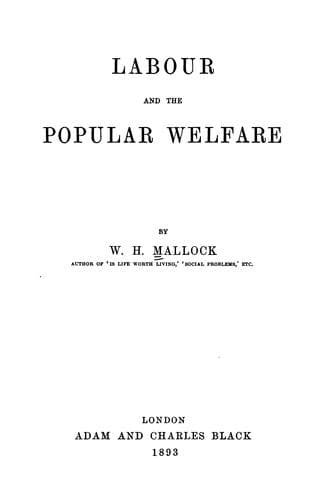
Labour and the Popular WelfareMallock, W. H. (William Hurrell)
General
Labour and the Popular Welfare
Mallock, W. H. (William Hurrell)
Labor; Labor movement; Socialism; Working class
There is, however, much more to be said. With each increase of their
wages which the labourers succeed in gaining, they will be better
equipping themselves for any fresh struggle in the future; for they
will be able to set aside a larger and larger fund on which to support
themselves without working, and thus be in a position to make the
struggle longer, or, in other words, to inflict still greater injury
on the employer. ◆¹ And if such will be the case when there is one
employer only, much more will it be the case when there are two—when
John and James, as we have seen, are forced by the necessities of
competition to grant part of the labourers’ demands, even before they
are formulated. It might thus seem that there is hardly any limit
to the power which a perfected system of Trade Unionism may one day
confer upon the labourers. There are, however, two which we will
consider now, in addition to others at which we will glance presently.
One is the limit with which we are already familiar, and of which in
this connection I shall again speak, namely, the limit of the minimum
reward requisite as a stimulus to Ability. The other is a limit closely
connected with this, which is constituted by the fact that if the
demands of Labour are pushed beyond a certain point against disunited
employers, the employers will combine against Labour, as Labour has
combined against them, and all further concessions will be, at all
costs, unanimously refused.
[Sidenote ◆1 The ultimate tendency of Trade Unionism is to make
any conflict between the employer and employed like a
conflict between two individuals.]
[Sidenote ◆2 The limit to which it can raise wages is fixed by the
minimum reward that suffices to make Ability operative.]
Public-domain text, read in full here on John Shaqi.
Reviews
Reviews
No reviews yet
Be the first to share your thoughts on this work.
Elsewhere in the archive
Join the Discussion
Join the discussion
Sign in to leave a comment or review.
Sign InorCreate an account