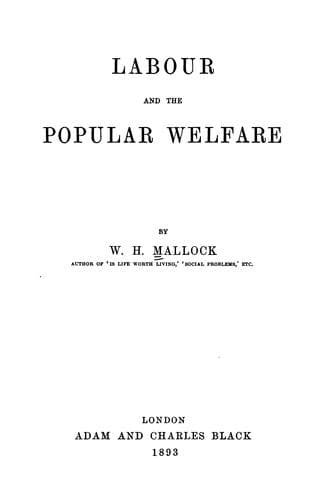
Labour and the Popular WelfareMallock, W. H. (William Hurrell)
General
Labour and the Popular Welfare
Mallock, W. H. (William Hurrell)
Labor; Labor movement; Socialism; Working class
◆¹ But in the case of Trade Unionism, just as in that of Socialism,
because the extent is limited to which it can raise the labourers’
income, it does not follow that within these limits its action may
not be of great and increasing benefit. ◆² Thus Mill, whose general
view of the subject coincides broadly with that of Professor Marshall,
points out that though a Union will never be able permanently to raise
wages above the point to which in time they would rise naturally, nor
permanently to keep them above a point to which they would naturally
fall, it can hasten the rise, which might otherwise be long delayed,
and retard the fall, which might otherwise be premature; and the gain
to Labour may thus in the long run be enormous. Unions have done this
for Labour in the past; and with improved and extended organisation,
they may be able to do it yet more effectively in the future; and
they have done, and may continue to do many other things besides—to do
them, and to add to their number. It is beyond my purpose to speak of
these things in detail. In the next chapter, I shall briefly indicate
some of them; but the main points on which I am concerned to insist are
simpler; and the next chapter—the last—will be devoted principally to
these.
CHAPTER V
_Of the enormous Encouragement to be derived by
Labour from a true View of the Situation;
and of the Connection between the Interests
of the Labourer and Imperial Politics._
[Sidenote ◆1 Let me again remind the reader of the object of this
book.]
[Sidenote ◆2 It is to show that the labourer’s income depends on
the general forces of production firstly, and secondly
on those of distribution.]
◆¹ The object of this work, as I explained in the opening chapter, is
to point out to the great body of the people—that is to say, to the
multitude of average men and women, whose incomes consist of the wages
of ordinary Labour—the conditions which determine the possibility of
these incomes being increased, and so to enable them to distinguish
the true means from the false, which they may themselves adopt with a
view to obtaining this result. ◆² And in order to show them how their
present incomes may be increased, I have devoted myself to showing
the reader how their present incomes have been obtained. I have done
this by fixing his attention on the fact that their present incomes
obviously depend upon two sets of causes: first, the forces that
produce the aggregate income of the country; and secondly, the forces
that distribute a certain portion of this amongst the labourers. And
these last I have examined from two points of view; first exhibiting
their results, and then indicating their nature. Let me briefly
recapitulate what I have said about both subjects.
Public-domain text, read in full here on John Shaqi.
Reviews
Reviews
No reviews yet
Be the first to share your thoughts on this work.
Elsewhere in the archive
Join the Discussion
Join the discussion
Sign in to leave a comment or review.
Sign InorCreate an account