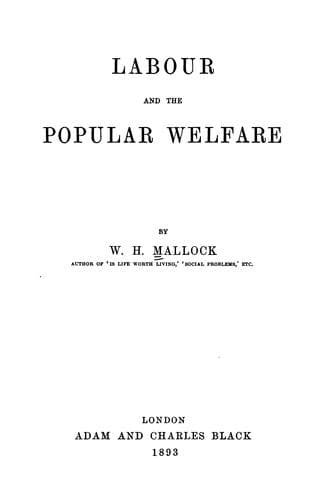
Labour and the Popular WelfareMallock, W. H. (William Hurrell)
General
Labour and the Popular Welfare
Mallock, W. H. (William Hurrell)
Labor; Labor movement; Socialism; Working class
The practical moral of all this is obvious. As to the normal and
spontaneous forces of distribution, what a study of them inculcates on
the labourer is not any principle of political action, but a general
temper of mind towards the whole existing system. It inculcates general
acquiescence, instead of general revolt. Now temper of mind, being
that from which policies spring, is quite as important as the details
of any of the policies themselves. Still it must be admitted that
were the normal forces of distribution the only forces that had been
at work for the labourer’s benefit, the principal lesson they would
teach him would be the lesson of _laisser aller_. But though these
forces have been the primary, they have not been the only forces; and
the deliberate policies by which men have controlled their operation,
and have applied them, have been equally necessary in producing the
desired results. The normal forces of distribution may be compared
to the waters of the Nile, which would indeed, as the river rises,
naturally fertilise the whole of the adjacent country, but which would
do as much harm as good, and do but half the good they might do, if
it were not for the irrigation works devised by human ingenuity. And
what these works are to the Nile, deliberate measures have been to the
normal forces of distribution. The growing volume of wealth, which is
spreading itself over the fields of Labour, even yet has failed to
reach an unhappy fraction of the community; the tides and currents flow
with intermittent force, which is often destructive, still more often
wasted, rarely husbanded and applied to the best advantage. Had it not
been for the deliberate action of men,—for legislation in favour of the
labourers, and their own combinations amongst themselves,—these evils
which have accompanied their general progress would have been greater.
◆¹ Wise action in the future will undoubtedly make them less; and may,
though it is idle to hope for Utopias in this world, cause the larger
and darker part of them to disappear.
[Sidenote ◆1 Much is to be done beyond the mere raising of the
labourers’ wages; and Trade Unionism and so-called
Socialism vary much.]
Public-domain text, read in full here on John Shaqi.
Reviews
Reviews
No reviews yet
Be the first to share your thoughts on this work.
Elsewhere in the archive
Join the Discussion
Join the discussion
Sign in to leave a comment or review.
Sign InorCreate an account