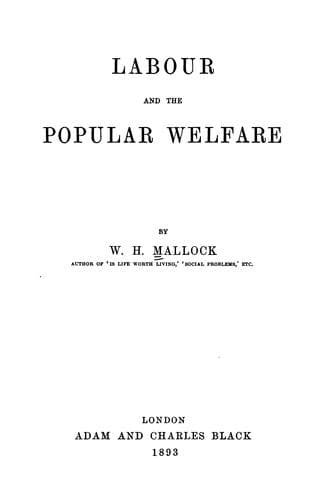
Labour and the Popular WelfareMallock, W. H. (William Hurrell)
General
Labour and the Popular Welfare
Mallock, W. H. (William Hurrell)
Labor; Labor movement; Socialism; Working class
The lesson, then, to be drawn from what I have urged in the preceding
chapter is, taken as a whole, no lesson of _laisser faire_. Though
neither Socialism nor Trade Unionism may have much, or perhaps any,
efficacy in raising the maximum of the labourer’s actual income,—though
this must depend on forces which are wholly different,—yet Trade
Unionism, and the principle which is called Socialism, may be of
incalculable service in bringing about conditions under which that
income may be earned with greater certainty, and under improved
circumstances, and, above all, be able to command more comforts,
conveniences, and enjoyments. Thus many of these measures which I have
called Socialistic under protest, may be regarded as an interception
of a portion of the labourer’s income, and an expenditure of it on his
account by the State in a way from which he derives far more benefit
than he would, or could have secured if he had had the spending of it
himself; whilst Trade Unionism, though it cannot permanently raise his
wages beyond a maximum determined by other causes, may, as has been
said before, raise them to this earlier than they would have risen
otherwise, and prevent what might otherwise occur—a fall in them before
it was imperative. ◆¹ Trade Unionism, however, has many other functions
besides the raising of wages. It aims—and aims successfully—at
diminishing the pain and friction caused amongst the labourers by the
vicissitudes alike of industry and of life. It has done much in this
direction already; and in the future it may do more.
The fact then that the normal forces of distribution must, if things
continue their present course, increase the income of the labourer,
even without any action on their own part, though it is calculated
to change the temper in which the labourers approach politics,
is, instead of being calculated to damp their political activity,
calculated to animate it with far more hope and interest than the
wild denunciations and theories of the contemporary agitator, which
those who applaud them do but half believe. It will to the labourer
be far more encouraging to feel that the problem before him is not
how to undermine a vast system which is hostile to him, and which,
though often attacked, has never yet been subverted, but merely to
accommodate more completely to his needs a system which has been, and
is, constantly working in his favour.
[Sidenote ◆1 Whilst as to mere wages, if the labourers will judge
of the possible near future from the actual near past,
the prospects before them must exceed their wildest
dreams hitherto.]
Public-domain text, read in full here on John Shaqi.
Reviews
Reviews
No reviews yet
Be the first to share your thoughts on this work.
Elsewhere in the archive
Join the Discussion
Join the discussion
Sign in to leave a comment or review.
Sign InorCreate an account