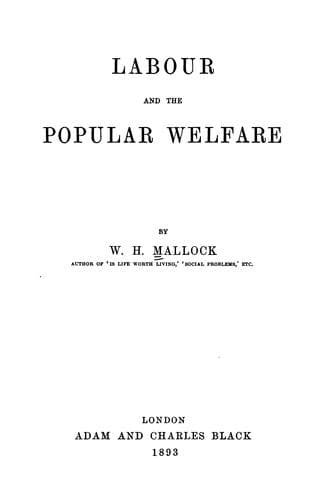
Labour and the Popular WelfareMallock, W. H. (William Hurrell)
General
Labour and the Popular Welfare
Mallock, W. H. (William Hurrell)
Labor; Labor movement; Socialism; Working class
And now comes what is practically the important deduction from these
facts. What has happened in the near past, will, other things being
equal, happen in the near future. If the same forces that have been
at work since the year 1850 continue to be at work, and if, although
regulated, they are not checked, the labourers of this country will in
another thirty years have nearly doubled the income which they enjoy
at present. Their income will have risen from something under _seven
hundred millions_ to something over _thirteen hundred millions_. The
labourers, in fact, will, so far as money goes, be in precisely the
same position as they would be to-day if, by some unheard-of miracle,
the entire present income of the country were suddenly made over to
them in the form of wages, and the whole of the richer classes were
left starving and penniless. This is no fanciful calculation. It is
simply a plain statement of what must happen, and will happen, if only
the forces of production continue to operate for another thirty years
as they have been operating steadily for the past hundred. Is not this
enough to stimulate the labourer’s hopes, and convince him that for him
the true industrial policy is one that will adjust his own relations
with the existing system better, and regulate better the flow of the
wealth which it promises to bring him, rather than a policy whose aim
is to subvert that system altogether, and in especial to paralyse the
force from which it derives its efficacy?
[Sidenote ◆1 But the one point to remember is that all their
prosperity depends on the continued action of Ability,
and the best conditions being secured for its operation,]
◆¹ And this brings me back to that main, that fundamental truth which
it is the special object of this volume to elucidate. The force which
has been at the bottom of all the labourers’ progress during the past,
and on the continued action of which depends all these hopes for their
future—that force is not Labour but Ability; it is a force possessed
and exercised not by the many but by the few. The income which Labour
receives already is largely in excess of what Labour itself produces.
Were Ability crippled, or discouraged from exerting itself, the entire
income of the nation would dwindle down to an amount which would not
yield Labour so much as it takes now; whilst any advance, no matter how
small, on what Labour takes now must come from an increasing product,
which Ability only can produce.
[Sidenote ◆1 Labour must remember that Ability is a living force
which cannot be appropriated as Capital might be; but
that it must be encouraged and propitiated.]
Public-domain text, read in full here on John Shaqi.
Reviews
Reviews
No reviews yet
Be the first to share your thoughts on this work.
Elsewhere in the archive
Join the Discussion
Join the discussion
Sign in to leave a comment or review.
Sign InorCreate an account