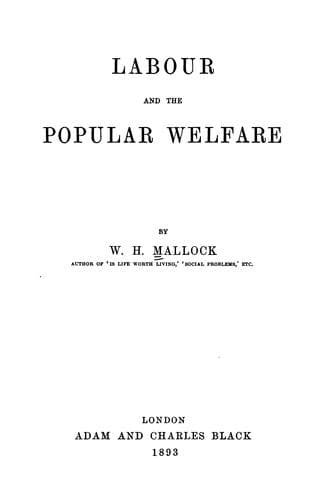
Labour and the Popular WelfareMallock, W. H. (William Hurrell)
General
Labour and the Popular Welfare
Mallock, W. H. (William Hurrell)
Labor; Labor movement; Socialism; Working class
◆¹ Hitherto this truth, though more or less apparent to economic
writers and thoughtful persons generally, has been apparent to them
only by fits and starts, and has never been assigned any definite
or logical place in their theories of production, or has ever been
expressed clearly; and, owing to this cause, not only has it been
entirely absent from the theories of the public generally, but its
place has been usurped by a meaningless and absurd falsehood. In place
of the living force Ability, residing in living men, popular thought,
misled by a singular oversight of the economists, has substituted
Capital—a thing which, apart from Ability, assists production as
little as a dead or unborn donkey; and hence has arisen that dangerous
and ridiculous illusion—sometimes plainly expressed, often only
half-conscious—to the effect that if the labourers could only seize
upon Capital they would be masters of the entire productive power of
the country. The defenders of the existing system have been as guilty
of this error as its antagonists; and the attack and defence have
been conducted on equally false grounds. Thus in a recent strike,
the final threat of the employers—men who had created almost the
whole of their enormous business—was that, if the strikers insisted
upon certain demands, the Capital involved in the business would be
removed to another country; and a well-known journal, professing to be
devoted to the interest of Labour, conceived that it had disposed of
this threat triumphantly by saying that, of the Capital a large part
was not portable, and that the employers might go if they chose, and
leave this behind. A great musician, who conceived himself to have been
ill-treated in London, might just as well have threatened that he would
remove his concert-room to St. Petersburg, when the principal meaning
of his threat would be that he would remove _himself_; and the journal
referred to might just as well have said, had the business in question
been the production of a great picture, “The painter may go if he
likes—what matter? We can keep his brushes.”
Public-domain text, read in full here on John Shaqi.
Reviews
Reviews
No reviews yet
Be the first to share your thoughts on this work.
Elsewhere in the archive
Join the Discussion
Join the discussion
Sign in to leave a comment or review.
Sign InorCreate an account