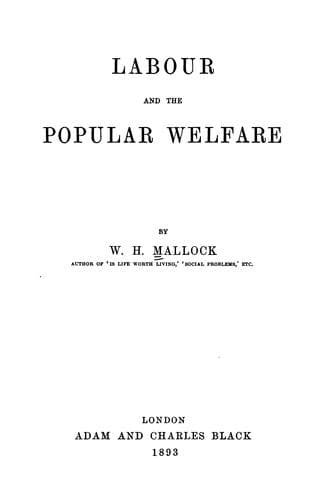
Labour and the Popular WelfareMallock, W. H. (William Hurrell)
General
Labour and the Popular Welfare
Mallock, W. H. (William Hurrell)
Labor; Labor movement; Socialism; Working class
◆¹ Nor, again, do we ascribe to Labour any undignified position in
insisting that much of its present income, and any possible increase
of it, is and must be taken from the wealth produced by Ability. For
even were there nothing more to be said than this, Labour is in a
position, or we assume it will be, to command from Ability whatever
sum may be in question, and can be neither despised nor blamed for
making the best bargain for itself that is possible. But its position
can be justified on far higher grounds than these. In the first place,
Labour, by submitting itself to the guidance of Ability,—no matter
whether the submission was voluntary, which it was not, or gradual,
unconscious, and involuntary, which it was,—surrendered many conditions
of life which were in themselves desirable, and has a moral claim on
Ability to be compensated for having done so; whilst Ability, for its
part, owes a moral debt to Labour, not upon this ground only, but on
another also—one which thus far has never been recognised nor insisted
on, but out of which arises a yet deeper and stronger obligation. I
have shown that of the present annual wealth of the nation Ability
creates very nearly two-thirds. But it may truly be said to have
created far more than this. It may be said to have created not only
two-thirds of the income, but also to have created two-thirds of the
inhabitants. If the minority of this country, in pursuit of their own
advantage, had not exercised their Ability and increased production as
they have done, it is not too much to say that of our country’s present
inhabitants _twenty-four millions_ would never have been in existence.
Those, then, who either contributed to this result themselves, or
inherit the Capital produced by those who did so, are burdened by the
responsibility of having called these multitudes into life; and thus
when the wages of Labour are augmented out of the proceeds of Ability,
Ability is not robbed, nor does Labour accept a largess, but a duty is
discharged which, if recognised for what it is, and performed in the
spirit proper to it, will have the effect of really uniting classes,
instead of that which is now so often aimed at—of confusing them.
[Sidenote ◆1 But Labour must not forget that it owes a debt to
Ability;]
[Sidenote ◆2 And that this debt will grow heavier as the national
wealth increases.]
◆¹ The labourers, on the other hand, must remember this: that having
been called into existence, no matter by what means, and presumably
wishing to live rather than be starved to death, they do not labour
because the men of Ability make them, but—as I have before pointed
out—because imperious Nature makes them; ◆² and that the tendency of
Ability is in the long run to stand as a mediator between them and
Nature, and whilst increasing the products of their Labour, to diminish
its duration and severity.
There are two further points which yet remain to be noticed.
Public-domain text, read in full here on John Shaqi.
Reviews
Reviews
No reviews yet
Be the first to share your thoughts on this work.
Elsewhere in the archive
Join the Discussion
Join the discussion
Sign in to leave a comment or review.
Sign InorCreate an account