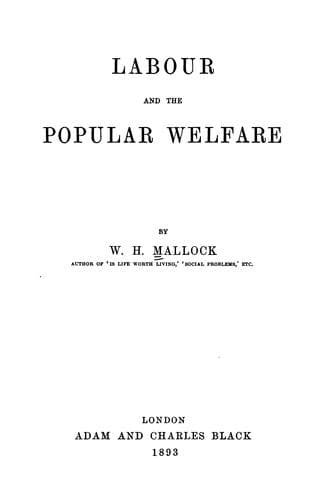
Labour and the Popular WelfareMallock, W. H. (William Hurrell)
General
Labour and the Popular Welfare
Mallock, W. H. (William Hurrell)
Labor; Labor movement; Socialism; Working class
I have hitherto spoken of the increase of wealth and wages, as if that
were the main object on which the labourers should concentrate their
attention, and which bound up their interests so indissolubly with
those of Ability. But it must also be pointed out that were Ability
unduly hampered, and its efficacy enfeebled either by a diminution of
its rewards, or by interference with its action, the question would
soon arise, not of how to increase wages, but of how to prevent their
falling. This point I have indeed alluded to already; but I wish now
to exhibit it in a new light. As I mentioned in an earlier chapter, of
the inhabitants of this country, who are something like _thirty-eight
millions_ in number, _twenty-six millions_ live on imported corn,
and about _thirteen millions_ live on imported meat; or, to put it
in another way, we all of us—the whole population—live on imported
meat for nearly _five months_ of the year, and on imported corn for
_eight months_; and were these foreign food supplies interfered with,
there are possibilities in this country of suffering, of famine, and
of horror for all classes of society, to which the entire history of
mankind offers us no parallel. This country, more than any country in
the world, is an artificial fabric that has been built up by Ability,
half of its present wealth being,—let me repeat once more,—the
marvellous product of the past fifty years; and the constant action
of Ability is just as necessary to prevent this from dwindling as
it is to achieve its increase. But in order that Ability may exert
itself, something more is needed than mere freedom from industrial
interference, or security for its natural rewards; and that is the
maintenance of the national or international position which this
country has secured for itself amongst the other countries of the world.
[Sidenote ◆1 And this brings us round to what is commonly called
Politics; which have, as this book will show, a far
closer interest for the labourer than is commonly
thought.]
Public-domain text, read in full here on John Shaqi.
Reviews
Reviews
No reviews yet
Be the first to share your thoughts on this work.
Elsewhere in the archive
Join the Discussion
Join the discussion
Sign in to leave a comment or review.
Sign InorCreate an account