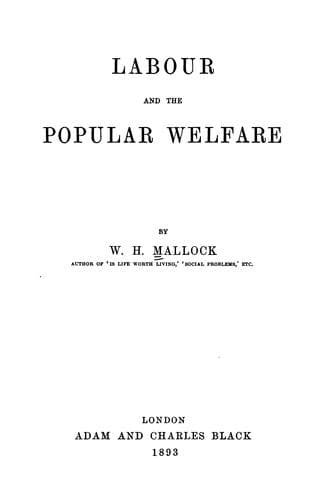
Labour and the Popular WelfareMallock, W. H. (William Hurrell)
General
Labour and the Popular Welfare
Mallock, W. H. (William Hurrell)
Labor; Labor movement; Socialism; Working class
at all events not produced by the multitude, and might, under changed
conditions, be no longer produced at all.
Now this doctrine of Ability Mr. Shaw accepts, and completely
surrenders and throws overboard the Socialistic doctrine of Labour. He
does indeed endeavour to make the surrender seem less complete than it
is, partly by irrelevant comments on some minor points,[61] and partly
by insisting on certain qualifications which are perfectly true, and to
which I have myself often elsewhere alluded, but which, as I shall show
presently, are, on his own admission, of small practical importance,
and do not appreciably affect the main position. For instance Mr.
Shaw argues that it is not always the most able man who, in any given
business, is to be found directing it. This also is no doubt true.
It merely means, however, that of industrial ability the same thing
may be said, which has so truly been said of Government—that it is
always _in_, or _passing into_, the hands of the most powerful section
of the community. Businesses conducted by men of inferior Ability
are gradually superseded by businesses conducted by men of superior
Ability. Men’s actual positions may be a few years behind or before
their capacities, but for all practical purposes they coincide with
them and the utmost that Mr. Shaw’s contention could prove would be
that some members of a minority are in places which should be occupied
by other members of a minority; not that the majority could take the
places of either.
But I merely mention these points in passing, and waste no pains in
insisting on them or pressing them home, because their practical
insignificance is admitted by Mr. Shaw himself. The great body of
men—of men selected at random, even if they should enjoy the advantages
of superior position and education—“could not,” he says, “invent a
wheelbarrow, much less a locomotive.” He amplifies this admission
by quoting the case of an acquaintance of his, whose exceptional
Ability secured him _four thousand pounds_ a year, because without the
assistance of that Ability his employer would have lost more than this
sum. “Other men,” he proceeds, “have an eye for contracts, or what not,
or are born captains of industry, in which case they go into business
on their own account, and make ten, twenty, or two hundred per cent,
_where you or I should lose five_.... All these people are _rentiers_
of Ability.” Again he quotes with emphatic approval a passage from an
American writer, whom he praises as a skilled economist; and using this
passage as a text, endorses its meaning in these words of his own.
“The able man, the actual organiser and employer, alone is able to find
a use for mere manual deftness, or for that brute strength, and heavy
bank balance, which any fool may possess.” “The capitalist and the
labourer run helplessly to the able man.” “He is the only party in the
transaction capable of the slightest initiative in production.”
Public-domain text, read in full here on John Shaqi.
Reviews
Reviews
No reviews yet
Be the first to share your thoughts on this work.
Elsewhere in the archive
Join the Discussion
Join the discussion
Sign in to leave a comment or review.
Sign InorCreate an account