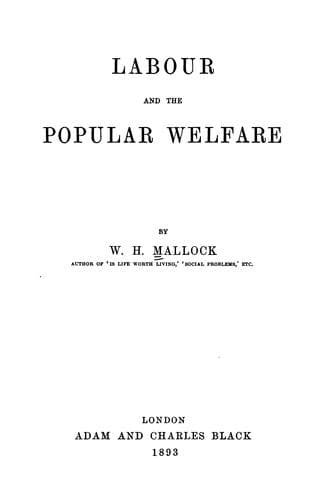
Labour and the Popular WelfareMallock, W. H. (William Hurrell)
General
Labour and the Popular Welfare
Mallock, W. H. (William Hurrell)
Labor; Labor movement; Socialism; Working class
I propose, then, to show, in as few words as possible, that Mr. Shaw
has not only proved himself incapable of shaking a single one of the
various arguments advanced by me, but that whilst flattering himself
that, in his own phrase, he has been taking his opponent’s scalp, the
scalp which he holds, and has really taken, is his own. His criticism
divides itself into two main parts. One is an admission of the truth
of one of the fundamental propositions on which I insisted. The second
is a complete evasion of another, and the substitution for it of an
ineptitude which is entirely of Mr. Shaw’s invention, and which he
finds it so easy and so exciting to demolish, that he sets it up as
often as he knocks it down, for the pleasure of displaying his prowess
over again.
Here, then, are three propositions to be dealt with: First, the
primary proposition on which I insisted, and the truth of which Mr.
Shaw admits; secondly, a proposition on which Mr. Shaw declares that
I insisted, but which is really an invention of his own; and thirdly,
a proposition on which I did insist actually, but which Mr. Shaw
never even states, much less attempts to meet. This third proposition
I shall briefly state once again when I have dealt with the two
others, and show how Fabian philosophy—indeed the philosophy of all
Socialism—completely fails to meet it.
To begin, then, with the first. My primary object has been to exhibit
the absolute falsehood of the Socialistic doctrine that _all wealth
is due to labour_, and to replace this by a demonstration that under
modern conditions of production, labour is not only not the sole
producer of wealth, but does not even produce the principal part of
it. The principal producing agent, I have pointed out, is what I have
called Industrial Ability—or the faculty which, whilst exercised by
a few, directs the labour of the many; and if this truth is once
accepted, it completely cuts away from Socialism the whole of its
existing foundations, and renders absolutely meaningless the whole of
its popular rhetoric. For the most powerful argumentative appeal which
Socialism can make to the majority is merely some amplification of the
statement, which is no doubt plausible, and is advanced by Socialists
as an axiom, that the exertions of the majority—or, in other words,
Labour—has produced all wealth, and that therefore the majority not
only ought to possess it, but will be able to possess it by the simple
process of retaining it. But the moment the productive functions of
industrial ability are made clear, the doctrine which seemed an axiom
is reduced to an absurdity; and what might before have seemed a paradox
becomes a simple and intelligible truth—the doctrine, namely, that a
comparatively few persons, with certain exceptional gifts, are capable
of producing more wealth than all the rest of the community; and that
whoever may produce the wealth which the rich classes possess, it is
Public-domain text, read in full here on John Shaqi.
Reviews
Reviews
No reviews yet
Be the first to share your thoughts on this work.
Elsewhere in the archive
Join the Discussion
Join the discussion
Sign in to leave a comment or review.
Sign InorCreate an account