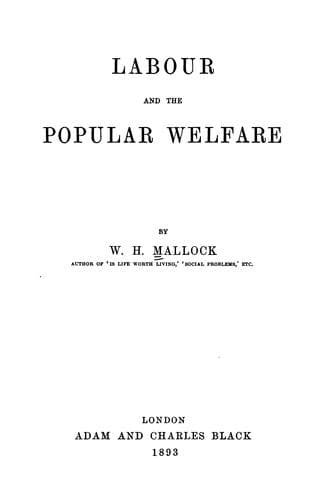
Labour and the Popular WelfareMallock, W. H. (William Hurrell)
General
Labour and the Popular Welfare
Mallock, W. H. (William Hurrell)
Labor; Labor movement; Socialism; Working class
I do not think that in my two recent articles in this Review there is
a single sentence that to any clear-headed man could form an excuse
for such a misconception as Mr. Shaw’s, whereas there are pages which
ought to have made it impossible. Indeed, a notice in the _Spectator_
disposes of Mr. Shaw by saying that he evades the real point raised
by me, not meeting what I did say, and combating what I did not say.
But, as I started with observing, magazine articles can rarely be
exhaustive, and I will assume that some incompleteness or carelessness
of expression on my part might have afforded, had these articles stood
alone, some excuse for their critic. Mr. Shaw, however, is at pains
to impress us that he has read other writings of mine on the same
subject. He even remembers, after an interval of more than ten years,
some letters I wrote to the _St. James’s Gazette_. It might, therefore,
have been not unreasonable to expect that he would have referred to
my recent volume, _Labour and the Popular Welfare_, which I expressly
referred to in my two articles, and in which I said I had stated my
position more fully. As an answer to Mr. Shaw I will quote from that
volume now.
The first Book deals with certain statistics as to production in this
country, and the growth of the national income as related to the
population. In the second Book I deal with the cause of this growth.
I point out that the causes of production are not three, as generally
stated—viz. Land, Labour, and Capital; but four—viz. Land, Labour,
Capital, and Ability; and that the fourth is the sole source of that
_increase_ in production which is the distinguishing feature of
modern industrial progress. In thus treating Capital as distinct from
Ability, I point out—taking a pumping-engine as an example—that capital
creates a product which necessarily goes to its owner, _quâ_ owner,
whether the owner is an individual or the State. I then proceed to
show that fixed capital—_e.g._ an engine—is the result of circulating
capital fossilised; and that circulating capital is productive only
in proportion as it is under the control of Ability. For this reason
I said that whilst it is _in process of being utilised_, Capital is
connected with Ability as the brain is connected with the mind, it
being the material means through which Ability controls Labour; and
that thus from _a certain point of view_ the two are inseparable. I
need not insist on this truth, because Mr. Shaw admits it. But Mr.
Shaw will find a subsequent chapter (Book IV. chap. ii.) bearing the
title, _Of the Ownership of Capital as distinct from its Employment by
Ability_. From that chapter I quote the following passage:—
Public-domain text, read in full here on John Shaqi.
Reviews
Reviews
No reviews yet
Be the first to share your thoughts on this work.
Elsewhere in the archive
Join the Discussion
Join the discussion
Sign in to leave a comment or review.
Sign InorCreate an account