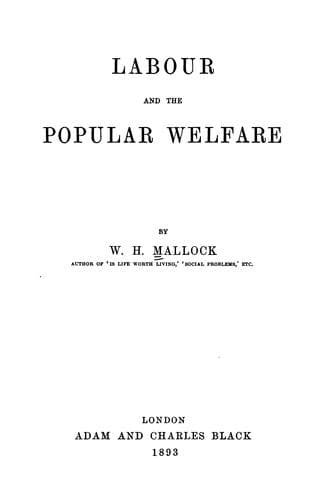
Labour and the Popular WelfareMallock, W. H. (William Hurrell)
General
Labour and the Popular Welfare
Mallock, W. H. (William Hurrell)
Labor; Labor movement; Socialism; Working class
“In dealing with Capital and Ability, I first treated them
separately, I then showed that, regarded as a productive agent,
Capital _is_ Ability, and must be treated as identical with it. But
it is necessary, now we are dealing with distribution, to dissociate
them for a moment and treat them separately once more. For even
though it be admitted that Ability, working by means of Capital,
produces, as it has been shown to do, nearly two-thirds of the
national income,[63] and though it may be admitted further that
a large portion of this product should go to the able men who are
actively engaged in producing it—the men whose Ability animates and
vivifies Capital—it may be argued that a portion of it, which is very
large indeed, goes as a fact to men who do not exert themselves at
all, or who, at any rate, do not exert themselves in the production
of wealth. These men, it will be said, live not on the products
of Ability, but on the interest of Capital, which they have come
accidentally to possess; and it will be asked on what ground Labour
is interested in forbearing to touch the possessions of those who
produce nothing?... Why should it not appropriate what goes to this
wholly non-productive class.”
If Mr. Shaw or his readers are still in doubt as to the extent to which
his criticism of myself is wide of the mark—if he still thinks that he
is fighting any mistake but his own, when he attacks me as though I
confused interest with the direct earnings of Ability, let me add one
passage more out of the same chapter:—
“Large profits must not be confounded with high interest. Large
profits are a mixture of three things, as was pointed out by Mill,
though he did not name two of them happily. He said that profits
consisted of wages of superintendence, compensation for risk, and
interest on Capital. If, instead of wages of superintendence we say
the product of Ability, and instead of compensation for risk we say
the reward of sagacity, which is itself a form of Ability, we shall
have an accurate statement of the case.”
Again, two pages earlier Mr. Shaw will find this:—
“Interest is capable, under certain circumstances, of being reduced
to a minimum without production being in any degree checked; and
every pound which the man who employs Capital is thus relieved from
paying to the man who owns it constitutes, _other things being
equal_, a fund which may be appropriated by Labour.”
These quotations will be enough to show how the bulk of Mr. Shaw’s
criticisms, which he thinks are directed against myself, are criticisms
of an absurd error and confusion of thought, which I have myself done
my utmost to expose, in order that I might put the real facts of the
case more clearly.
Public-domain text, read in full here on John Shaqi.
Reviews
Reviews
No reviews yet
Be the first to share your thoughts on this work.
Elsewhere in the archive
Join the Discussion
Join the discussion
Sign in to leave a comment or review.
Sign InorCreate an account