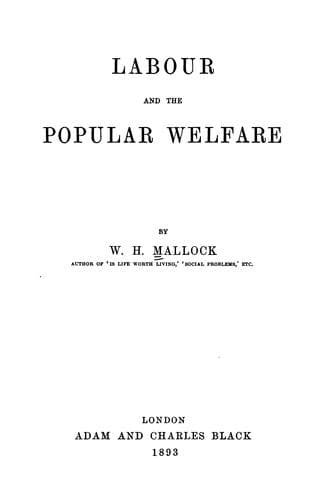
Labour and the Popular WelfareMallock, W. H. (William Hurrell)
General
Labour and the Popular Welfare
Mallock, W. H. (William Hurrell)
Labor; Labor movement; Socialism; Working class
[47] The entire population has risen from about _twenty-seven million
five hundred thousand_ to _thirty-eight millions_. But a large part of
this increase has taken place amongst the classes who pay income-tax,
and are expressly excluded from the above calculations. These classes
have risen from _one million five hundred thousand_ to _five millions_.
[48] These considerations are so obvious, and have been so constantly
dwelt upon by all economic writers, other than avowed Socialists,
that it is quite unnecessary here to insist on these further. Even
the Socialists themselves have recognised how much force there is in
them, and have consequently been at pains to meet them by the following
curious doctrine. They maintain that a man who makes or inherits a
certain sum has a perfect right to possess it, to hoard it, or squander
it on himself; but no right to any payment for the use made of it by
others. They argue that if he puts it into a business he is simply
having it preserved for him; for the larger part of the Capital at any
time existing would dwindle and disappear if it were not renewed by
being used. Let him put it into a business, say the Socialists, and
draw it out as he wants it. Few things can show more clearly than this
suggested arrangement the visionary character of the Socialistic mind;
for it needs but little thought to show that such an arrangement would
defeat its own objects and be altogether impracticable. The sole ground
on which the Socialists recommend it, in preference to the arrangement
which prevails at present, is that the interest which the owners of
the Capital are forbidden to receive themselves would by some means
or other be taken by the State instead and distributed amongst the
labourers as an addition to their wages, and would thus be the means
of supplying them with extra comforts. Now the interest if so applied
would, it is needless to say, be not saved but consumed. But the owners
of the Capital, who are thus deprived of their interest, are to have
the privilege, according to the arrangement we are considering, of
consuming their Capital in lieu of the interest that has been taken
from them. Accordingly, whereas the interest is all that is consumed
now, under this arrangement the Capital would be consumed as well. The
tendency, in fact, of the arrangement would be neither more nor less
than this: to increase the consumption of the nation at the expense of
its savings, until at last all the savings had disappeared. It would be
impracticable also for many other reasons, to discuss which here would
simply be waste of time. It is enough to observe that the fact of its
having been suggested is only a tribute to the insuperable nature of
the difficulty it was designed to meet.
Public-domain text, read in full here on John Shaqi.
Reviews
Reviews
No reviews yet
Be the first to share your thoughts on this work.
Elsewhere in the archive
Join the Discussion
Join the discussion
Sign in to leave a comment or review.
Sign InorCreate an account