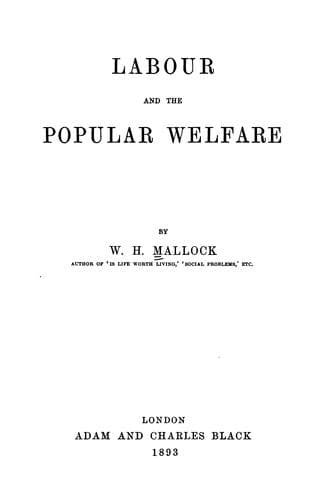
Labour and the Popular WelfareMallock, W. H. (William Hurrell)
General
Labour and the Popular Welfare
Mallock, W. H. (William Hurrell)
Labor; Labor movement; Socialism; Working class
[49] The part played in national progress by the mere business
sagacity of investors, amounts practically to a constant criticism of
inventions, discoveries, schemes, and enterprises of all kinds, and the
selection of those that are valuable from amongst a mass of what is
valueless and chimerical.
[50] See Mr. Giffen’s Inaugural Address of the Fiftieth Session of the
Statistical Society.
[51] The gross amount assessed to income-tax in 1891 was nearly _seven
hundred million pounds_; now more than _a hundred million pounds_ was
exempt, as belonging to persons with incomes of less than _a hundred
and fifty pounds_ a year. Mr. Giffen maintains (see his evidence given
before the Royal Commission on Labour, 7th December 1892) that there
is an immense middle-class income not included amongst the wages of
the labouring class. This, according to the classification adopted
above, which divides the population into those with incomes above, and
those with incomes below _a hundred and fifty pounds_, would raise the
collective incomes of the latter to over _seven hundred million pounds_.
[52] See Mr. Giffen’s Address, as above.
[53] If the number of employers does not increase, it is true that
they, unlike the employed, will be richer in proportion to their
numbers; but they will be poorer in proportion to the number of men
employed by them.
[54] Thus the old theory of the wage-fund, which has so often been
attacked of late, has after all this great residuary truth, namely,
that the amount of wealth that is spent and taken in wages is limited
by the total amount of wealth produced _in proportion to the number_
of labourers who assist in its production. That theory, however, as
commonly understood, is no doubt erroneous, though not for the reasons
commonly advanced by its critics. The theory of a wage-fund as commonly
understood means this—that if there were eight labourers and a capital
of _four hundred pounds_, which would be spent in wages and replaced
within a year, and if this were distributed in equal shares of _fifty
pounds_, it would be impossible to increase the share of one labourer
without diminishing that of the others; or to employ more labourers
without doing the same thing. But the truth is that if means were
discovered by which the productivity of any one labourer could be
doubled during the first six months, the whole _fifty pounds_ destined
for his whole year’s subsistence might be paid to him during the first
six months, and the fund would meanwhile have been created with which
to pay him a similar sum for the next six months—the employer gaining
in the same proportion as the labourer. So, too, with regard to an
additional number of labourers—if ability could employ their labour to
sufficient advantage, part of the sum destined to support the original
labourer for the second six months of the year might be advanced to
them, and before the second six months’ wages became due there might be
enough to pay an increased wage to all.
Public-domain text, read in full here on John Shaqi.
Reviews
Reviews
No reviews yet
Be the first to share your thoughts on this work.
Elsewhere in the archive
Join the Discussion
Join the discussion
Sign in to leave a comment or review.
Sign InorCreate an account