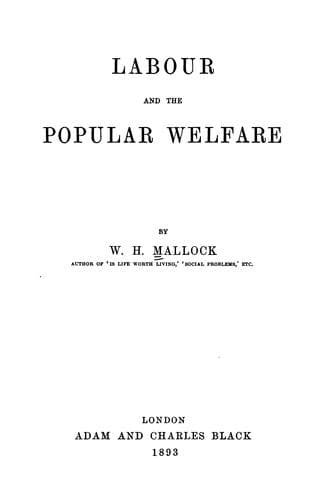
Labour and the Popular WelfareMallock, W. H. (William Hurrell)
General
Labour and the Popular Welfare
Mallock, W. H. (William Hurrell)
Labor; Labor movement; Socialism; Working class
[61] Mr. Shaw, for instance, is at much pains to point out that Ability
is not one definite thing, as the power of jumping is, and makes
himself merry by asking if Wellington’s Ability could be compared
with Cobden’s, or Napoleon’s with Beethoven’s. This is all beside the
mark. I have been careful to define the sense in which I used the
word Ability—to define it with the utmost exactness. I have said that
I use it as meaning productive Ability—industrial Ability. That is
to say, those faculties by which men, not labouring themselves, are
capable of directing to the best advantage the labour of others, with
a view to the production of economic commodities. In the Middle Ages I
said that another kind of Ability was more important—_i.e._ Military
Ability, instead of Economic; and the historical importance of this
fact, which Mr. Shaw says I discovered only after I had written my
first article on Fabian Economics, I insisted on, at much greater
length, years ago, when criticising Karl Marx’s “Theory of Value,” in
this [the Fortnightly] Review. Again, let Mr. Shaw turn to _Labour and
the Popular Welfare_, p. 328, and he will find what he says put more
clearly by myself than by him.
[62] It is interesting to see the analysis which Mr. Shaw gives of the
elements which make up the _five hundred million pounds_ (see page 482
of his article). It shows a curious want of sense of proportion, and
reads much like a statement that a young man’s bankruptcy was due to
the _one hundred thousand pounds_ he has spent on the turf, the _fifty
thousand pounds_ he had spent on building a house, the _fifty pounds_
he has spent on a fur coat, and the sixpence he gave last Saturday to
the porter at Paddington Station. But there is in it a more serious
error than this. Mr. Shaw says, and rightly, that a large part of the
millions to which he alludes consists of payments to artists and other
professional men (_e.g._ doctors), by very rich commonplace people
competing for their services. But he entirely mistakes the meaning of
this fact. I have pointed it out carefully in _Labour and the Popular
Welfare_ (Book I. chap. iii.) and have illustrated it by one of the
exact cases Mr. Shaw has in view, viz. that of a doctor who gets a fee
of _one thousand two hundred pounds_ from “a very rich commonplace
person.” I pointed out that in the estimates, from which Mr. Shaw gets
his figures of _five hundred million pounds_, all such payments are
counted twice over. The “very rich commonplace person” and the doctor
both pay income-tax on and are regarded as possessing the same _one
thousand two hundred pounds_. As matters stand this is right enough,
for the patient receives either in good or fancied good an equivalent
for his fee in the doctor’s services; but if the sum in question were
to be divided up and distributed, there would for distribution be one
_one thousand two hundred pounds_ only. By reference to calculations
Public-domain text, read in full here on John Shaqi.
Reviews
Reviews
No reviews yet
Be the first to share your thoughts on this work.
Elsewhere in the archive
Join the Discussion
Join the discussion
Sign in to leave a comment or review.
Sign InorCreate an account