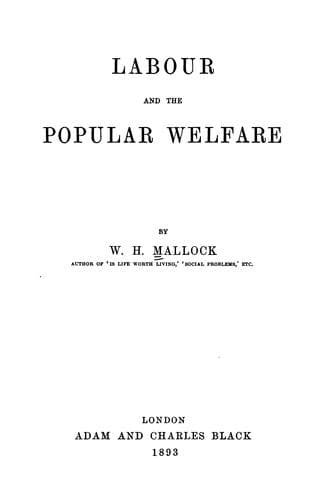
Labour and the Popular WelfareMallock, W. H. (William Hurrell)
General
Labour and the Popular Welfare
Mallock, W. H. (William Hurrell)
Labor; Labor movement; Socialism; Working class
of Professor Leone Levi, with whom I corresponded on these matters, I
drew the conclusion that the sum thus counted twice over was about _one
hundred million pounds_ annually ten years ago. This would knock off
twenty per cent at once from Mr. Shaw’s _five hundred million pounds_;
and I may again mention Mr. Giffen’s emphatic warning that, if we are
thinking of any general redistribution, another _two hundred million
pounds_ would have to be deducted from the sums which persons like Mr.
Shaw imagine await their seizure.
[63] The case may also be put in another way. Interest is the product
of capital _quâ_ capital, as opposed to the product of ability as
distinct from capital. But the bulk of modern capital is historically
the creation of ability, which has miraculously multiplied the few
loaves and fishes existing at the close of the last century. Interest
may therefore be called the secondary or indirect product of ability,
whilst earnings and profits may be called the direct product of
ability. Any one who is living on interest at the present moment is
almost sure to be living, not on his own ability, but on the products
of the ability of some member of his own family who has added to the
national wealth within the past two generations. Suppose a man who
died in 1830 left a fortune of _two hundred thousand pounds_, which he
made, as Salt did, by the invention and production of some new textile
fabric; and suppose that this fortune is now in the hands of a foolish
and feeble grandson, who enjoys _eight thousand pounds_ a year. This
is evidently not the product of the grandson’s ability; but it is the
product of the ability of the grandfather. The truth of this may be
easily seen by altering the supposition thus—by supposing that the
original maker of the fortune, instead of dying in 1830, is alive now,
but as imbecile as we supposed his grandson to be. He has, we will say,
long retired from business, and lives on the interest of the capital
he made when his faculties were in their vigour. Would any one say
that he is not living on his own ability? The only difference is—and
it is a difference which, from many points of view, is of the greatest
importance—that formerly he was living on the direct product of his
ability, and he is now living on its indirect product.
THE END
_Printed by_ R. & R. CLARK, _Edinburgh_.
———————————————————————————————————————————————————————
PRINCIPLES OF
POLITICAL ECONOMY
By J. SHIELD NICHOLSON, M.A., D.Sc.
PROFESSOR OF POLITICAL ECONOMY IN THE UNIVERSITY OF EDINBURGH,
SOME TIME EXAMINER IN THE UNIVERSITIES OF CAMBRIDGE,
LONDON, AND VICTORIA
In 2 Vols. demy 8vo.
Vol. I. price 15s.
_ALSO BY THE SAME AUTHOR_
Public-domain text, read in full here on John Shaqi.
Reviews
Reviews
No reviews yet
Be the first to share your thoughts on this work.
Elsewhere in the archive
Join the Discussion
Join the discussion
Sign in to leave a comment or review.
Sign InorCreate an account