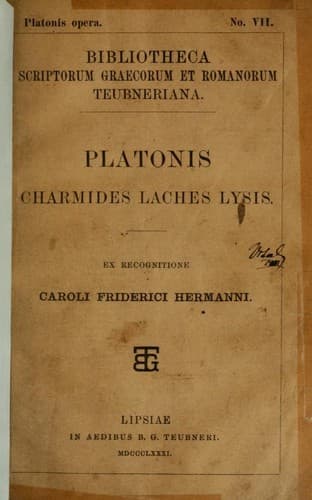
Classical literature; Courage -- Early works to 1800; Socrates, 470 BC-399 BC
SOCRATES: Must we not then first of all ask, whether there is any one of
us who has knowledge of that about which we are deliberating? If there
is, let us take his advice, though he be one only, and not mind the
rest; if there is not, let us seek further counsel. Is this a slight
matter about which you and Lysimachus are deliberating? Are you not
risking the greatest of your possessions? For children are your riches;
and upon their turning out well or ill depends the whole order of their
father's house.
MELESIAS: That is true.
SOCRATES: Great care, then, is required in this matter?
MELESIAS: Certainly.
SOCRATES: Suppose, as I was just now saying, that we were considering,
or wanting to consider, who was the best trainer. Should we not select
him who knew and had practised the art, and had the best teachers?
MELESIAS: I think that we should.
SOCRATES: But would there not arise a prior question about the nature of
the art of which we want to find the masters?
MELESIAS: I do not understand.
SOCRATES: Let me try to make my meaning plainer then. I do not think
that we have as yet decided what that is about which we are consulting,
when we ask which of us is or is not skilled in the art, and has or has
not had a teacher of the art.
NICIAS: Why, Socrates, is not the question whether young men ought or
ought not to learn the art of fighting in armour?
SOCRATES: Yes, Nicias; but there is also a prior question, which I
may illustrate in this way: When a person considers about applying a
medicine to the eyes, would you say that he is consulting about the
medicine or about the eyes?
NICIAS: About the eyes.
SOCRATES: And when he considers whether he shall set a bridle on a horse
and at what time, he is thinking of the horse and not of the bridle?
NICIAS: True.
SOCRATES: And in a word, when he considers anything for the sake of
another thing, he thinks of the end and not of the means?
NICIAS: Certainly.
SOCRATES: And when you call in an adviser, you should see whether he too
is skilful in the accomplishment of the end which you have in view?
NICIAS: Most true.
SOCRATES: And at present we have in view some knowledge, of which the
end is the soul of youth?
NICIAS: Yes.
SOCRATES: And we are enquiring, Which of us is skilful or successful in
the treatment of the soul, and which of us has had good teachers?
LACHES: Well but, Socrates; did you never observe that some persons,
who have had no teachers, are more skilful than those who have, in some
things?
SOCRATES: Yes, Laches, I have observed that; but you would not be very
willing to trust them if they only professed to be masters of their art,
unless they could show some proof of their skill or excellence in one or
more works.
LACHES: That is true.
Public-domain text, read in full here on John Shaqi.
Reviews
Reviews
No reviews yet
Be the first to share your thoughts on this work.
Join the Discussion
Join the discussion
Sign in to leave a comment or review.
Sign InorCreate an account