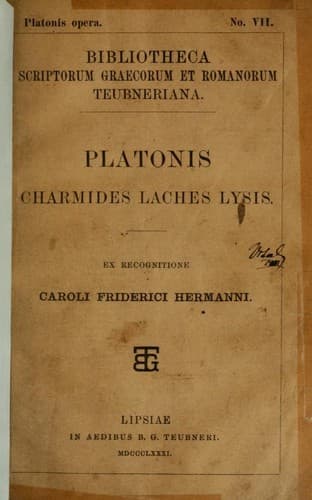
Classical literature; Courage -- Early works to 1800; Socrates, 470 BC-399 BC
noble? For if this is your first attempt at education, there is a danger
that you may be trying the experiment, not on the 'vile corpus' of a
Carian slave, but on your own sons, or the sons of your friend, and,
as the proverb says, 'break the large vessel in learning to make pots.'
Tell us then, what qualities you claim or do not claim. Make them tell
you that, Lysimachus, and do not let them off.
LYSIMACHUS: I very much approve of the words of Socrates, my friends;
but you, Nicias and Laches, must determine whether you will be
questioned, and give an explanation about matters of this sort.
Assuredly, I and Melesias would be greatly pleased to hear you answer
the questions which Socrates asks, if you will: for I began by saying
that we took you into our counsels because we thought that you would
have attended to the subject, especially as you have children who, like
our own, are nearly of an age to be educated. Well, then, if you have no
objection, suppose that you take Socrates into partnership; and do you
and he ask and answer one another's questions: for, as he has well said,
we are deliberating about the most important of our concerns. I hope
that you will see fit to comply with our request.
NICIAS: I see very clearly, Lysimachus, that you have only known
Socrates' father, and have no acquaintance with Socrates himself: at
least, you can only have known him when he was a child, and may have
met him among his fellow-wardsmen, in company with his father, at a
sacrifice, or at some other gathering. You clearly show that you have
never known him since he arrived at manhood.
LYSIMACHUS: Why do you say that, Nicias?
NICIAS: Because you seem not to be aware that any one who has an
intellectual affinity to Socrates and enters into conversation with
him is liable to be drawn into an argument; and whatever subject he may
start, he will be continually carried round and round by him, until at
last he finds that he has to give an account both of his present and
past life; and when he is once entangled, Socrates will not let him go
until he has completely and thoroughly sifted him. Now I am used to his
ways; and I know that he will certainly do as I say, and also that
I myself shall be the sufferer; for I am fond of his conversation,
Lysimachus. And I think that there is no harm in being reminded of any
wrong thing which we are, or have been, doing: he who does not fly from
reproof will be sure to take more heed of his after-life; as Solon says,
he will wish and desire to be learning so long as he lives, and will not
think that old age of itself brings wisdom. To me, to be cross-examined
by Socrates is neither unusual nor unpleasant; indeed, I knew all along
that where Socrates was, the argument would soon pass from our sons to
ourselves; and therefore, I say that for my part, I am quite willing to
discourse with Socrates in his own manner; but you had better ask our
friend Laches what his feeling may be.
Public-domain text, read in full here on John Shaqi.
Reviews
Reviews
No reviews yet
Be the first to share your thoughts on this work.
Join the Discussion
Join the discussion
Sign in to leave a comment or review.
Sign InorCreate an account